


Hey Toaster Readers,
This week is sponsored by our friends at Fintel Connect.
We’ll start with TransUnion, which put Bankrate‘s lender marketplace and its Monevo offers engine inside Credit Essentials, its free credit app.
Then Bank of America, Wells Fargo, Synchrony and BBVA join Poppy, the “bring your own AI agent” protocol, and Truist agrees to sell LightStream‘s $7.7 billion loan book to Carlyle while installing new consumer banking leadership.
Let’s get toasting!
- Carlos Caro & Nick Madrid, Founders of The Free Toaster
PS: We’re actively planning our Spring 2027 Affiliate Marketing Summit For Lenders and Publishers event in NYC! If you’re interested in sponsoring that event, please reply to this email or write us at info@thefreetoaster.com.
PS: To support us, please subscribe or forward this email to 1 of your colleagues!
TransUnion Puts Bankrate’s Lender Marketplace Inside Credit Essentials
Bankrate’s Auction and the Monevo Offers Engine Are Live in TransUnion’s Free Credit App, With Publishers and AI Assistants to Come
On October 14th, TransUnion announced a new capability that combines Bankrate‘s lender marketplace with TransUnion‘s credit data and its Monevo offers technology. It is already live in Credit Essentials, the free credit app and web experience TransUnion launched in May 2025.
The release describes the capability as building on more than a decade of collaboration between the two companies. Bankrate‘s lender network and its marketplace and auction technology put lenders in real-time competition for consumers, which TransUnion says means matches cover “more products, more providers and more competitive offers.” Monevo draws on credit data, alternative data and what the release calls “consumer intent signals,” and its decisioning engine matches each consumer with offers from a broad panel of lenders.
Partners can embed the capability through what TransUnion describes as a low-lift technical integration. Beyond Credit Essentials, it can extend to publisher and affiliate sites, co-branded experiences for financial institutions and brands, and AI assistants, “where more consumers now start their search for credit.” TransUnion and Bankrate say they are exploring more product types to extend the offers to publishers, partners, lender platforms and AI-driven channels, and call Credit Essentials “the first of many experiences the combined capability will power.”
The Credit Essentials numbers: millions of registrations since launch, with membership up approximately 50% in the last year. TransUnion‘s Q3 2026 Consumer Pulse study found that 53% of Americans check their credit report at least monthly, 93% believe monitoring it is important, and one in 10 of those who check do so to learn which credit offers they may qualify for. Members get free daily access to their TransUnion credit report and score, real-time alerts, credit education and personalized offers across credit cards, personal loans, mortgages, home equity, auto refinance, insurance and savings accounts.
“Consumers have many credit choices and not enough clarity,” said Steve Chaouki, President, U.S. Markets at TransUnion. “By combining TransUnion’s data with our Monevo offers platform and Bankrate’s lender partnerships, we’ve built a capability that makes offers more precise. Credit Essentials is our first proof point, and we’ll bring this to many more experiences where consumers and lenders meet.”
Matt Fellowes, CEO of Bankrate: “TransUnion’s data and identity insights, combined with Bankrate’s lender relationships, auctions and marketplace, help consumers find the right products with confidence.” [TransUnion]
Toaster’s Take: This is the Monevo deal doing what we said it would back in January 2025 (TransUnion paid $56 million for the 70% of Monevo it didn’t own; we further unpacked the deal on our News Pod #7). The bureau now owns the offers engine between lenders and publishers, and as more credit shopping starts online, that engine decides which offers a consumer sees and whether some lenders get seen at all. We’ll watch whether TransUnion and Bankrate show up inside an AI assistant, where Experian is already live with cards and loans, or keep the offers in TransUnion’s own app.
Sponsored by Fintel Connect
Just launched: The 2026 AI Search Guide for Financial Marketers
Growth teams at banks and fintechs are still asking how to show up in AI search. The better question is how to get recommended, because showing up and getting chosen are two different outcomes.
Fintel Connect analyzed 2,400 AI responses across personal lending, consumer credit cards, business credit cards, and high-yield savings accounts to find out what determines whether a financial brand gets named or recommended in AI-generated answers, and what that means for content investment and affiliate strategy.
What you’ll learn:
Where to allocate AI search investments to get the fastest results
A clear foundation on which prompts to target, which affiliates drive visibility in your product category, and how to build and track a strategy from the ground up
Category-level benchmarks and competitive data to identify what’s working, where visibility is being lost, and how to optimize results
BofA, Wells Fargo, Synchrony and BBVA Join the Personal Agent Protocol
Bank of America, BBVA, Synchrony and Wells Fargo have signed on as design partners for the Personal Agent Protocol, or Poppy, an open standard that lets a consumer’s own AI agent work with a company through its website, its APIs or an agent of its own, American Banker reported on October 15th. Sierra, Meta, Stripe, Walmart, Shopify and Rocket are among the companies that announced the protocol on October 6th; Sierra published the draft on October 9th with 35 design partners that also include Chime, PayPal, Visa, Mastercard, Plaid and OpenAI. “Poppy is built on the principle that customers decide what access to give their personal agents, and companies set parameters for what those agents can do,” per Sierra.
American Banker calls the idea “bring your own agent.” Robinhood already lets customers connect their preferred large language model to its model context protocol; JPMorganChase and Amazon have said they would block third-party agents. At Sierra Summit, Alex McGillis, VP of Product at Rocket, asked Meta‘s Muse agent for a mortgage pre-approval; Muse found Rocket‘s agent through Poppy, asked permission to connect, and after McGillis signed in to share credit and income details, the two agents produced a pre-approval letter.
Richard Crone, CEO of Crone Consulting, told American Banker the banks “are going to recognize that the consumer is going to want to bring their preferred agent,” and sees a cost reason too: Crone Consulting estimates an agentic banking session runs 15,000 to 50,000 tokens. “The only way to do this is to delegate that cost to the consumer’s own LLM. Bank of America didn’t buy you a cell phone, and they didn’t pay for your data plan when they launched mobile banking.” [Sierra] [American Banker]
Toaster’s Take: We covered Experian’s Agent Trust framework (our May 6 SoFi edition) and Robinhood’s agentic card in May; Poppy is the first time we’ve seen banks this size put their names on a consumer-chosen agent standard, with JPMorgan on the other side of the door. We’ll watch whether Rocket’s demo, a mortgage pre-approval that starts inside the consumer’s agent, becomes a channel lenders can measure and bid on.
Truist Agrees to Sell LightStream to Carlyle, Names New Consumer Banking Leaders
Six weeks into CEO Mike Lyons’ tenure, Truist said on October 16th that it has agreed to sell substantially all of the assets of LightStream, the direct-to-consumer unsecured lending platform it acquired in 2012, to Carlyle. The agreement, signed October 14th, covers $7.7 billion of loans and is expected to generate $7.2 billion of net proceeds, which Truist plans to use to repay wholesale borrowings. Truist‘s earnings deck calls LightStream a “non-core, loan only business generating a below target ROTCE” and anticipates closing in Q4 2026. It follows September’s exit from near-prime auto lending, when the $5.5 billion Regional Acceptance Corp. portfolio sold for $5.2 billion.
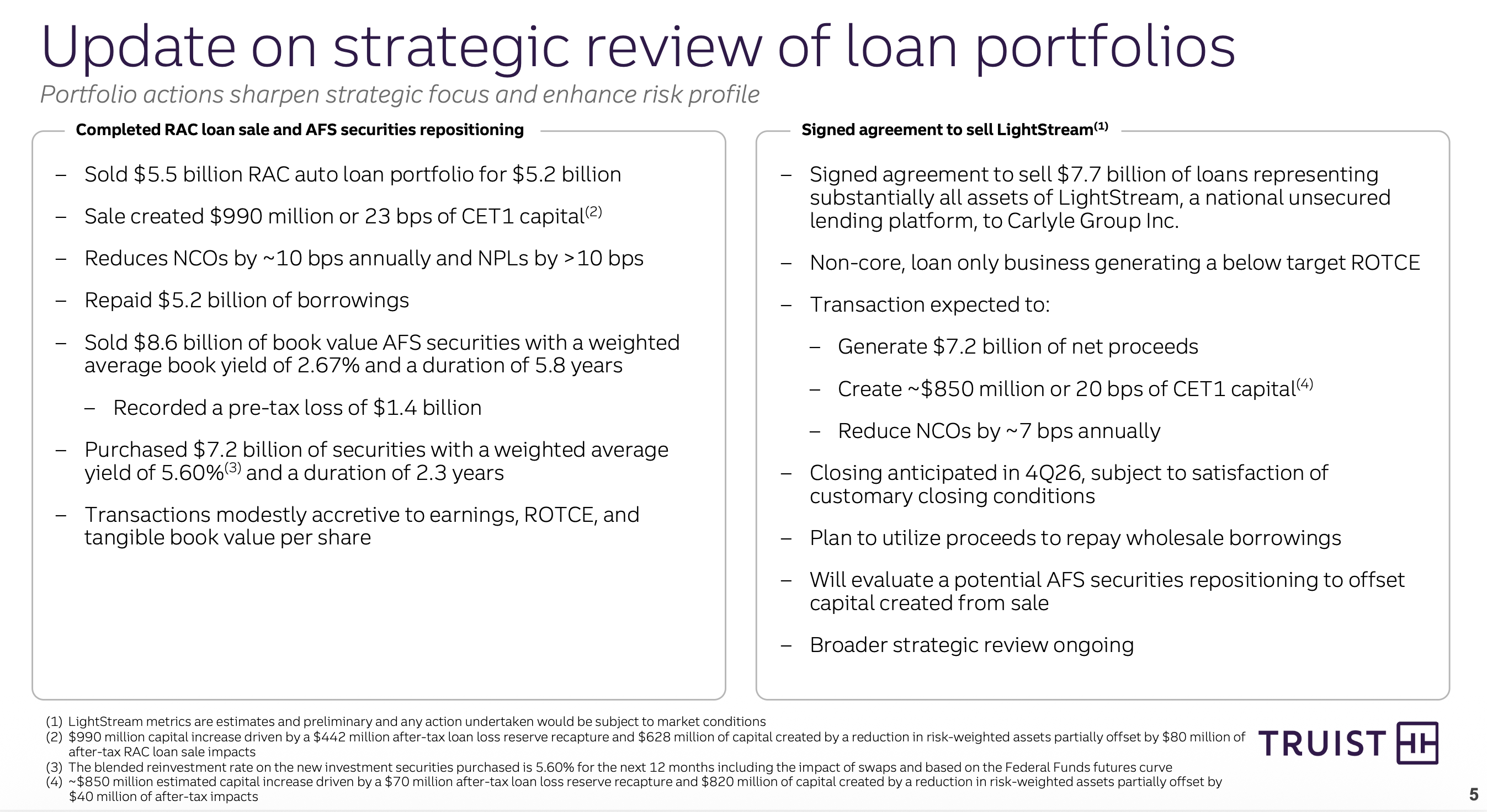
Truist also named new consumer leadership, all reporting to Lyons: D. Steve Boland, formerly Chief Administrative Officer at Bank of America, as Vice Chair; Shimna Sameer, a 20-year Bank of America veteran, as Chief Consumer Banking Officer, charged with growing core deposits and deepening primary banking relationships; and Jeff Warner, most recently Head of Small Business at PNC, as Chief Small Business Banking Officer. Dontá Wilson, Chief Consumer and Small Business Banking Officer, is leaving.
Gaurav Agarwal, a Chief Credit Officer in consumer lending and Capital One alum, ran the deal math on LinkedIn: about 93.5 cents on the dollar, which by his estimate implies a 3% to 3.5% annual loss rate and an unlevered return to Carlyle of 10% to 11%. “Not a bad deal for Carlyle.” For Truist, he figures the sale frees up about 20 basis points of CET1 against the 2% to 3% of loan amount it likely spent acquiring those borrowers. “That’s especially costly since LightStream charges no origination fees to offset it.” [Truist 8-K] [Truist] [Truist Q3 26 Earnings Presentation] [American Banker] [LinkedIn]
Toaster’s Take: The thread under Agarwal’s post lands on the two questions we’d ask: where LightStream’s lending team ends up, and who picks up its share of prime personal loans. We’ll keep our eyes out for both once the deal closes.
See you next week!
And Finally: We’re actively planning our Spring 2027 Affiliate Marketing Summit For Lenders and Publishers event in NYC! If you’re interested in sponsoring that event, please reply to this email or write us at info@thefreetoaster.com.