


Hey Toaster Readers,
This week is sponsored by our friends at Spinwheel.
This one is mostly an editorial, and we're putting a prediction on record: we think there will be a Claude Card and a ChatGPT Card. The road there starts with this week's news, Samsung's new Galaxy Card and its too-good-to-be-true rewards program, runs through who really pays for it and why, and ends with the one question that matters for every card issuer: whose card does your AI agent swipe by default?
First section is straight news. Everything after is opinion, and we'll label the line. Oh, and be sure to hold us to the prediction.
Let's get toasting!
BUT FIRST, A TOASTER EVENT ALERT 👀
The Affiliate Marketing Summit For Lenders & Publishers
New Publishers & Lenders are signing up every week
September 23, 2026 - San Francisco
Day 2 (relationship building in wine country) is almost sold out
Learn more at events.thefreetoaster.com
Thank you to our event sponsors! Experian, Engine by Gen, & Prism Data
The Galaxy Card Is Samsung’s Answer to the Apple Card
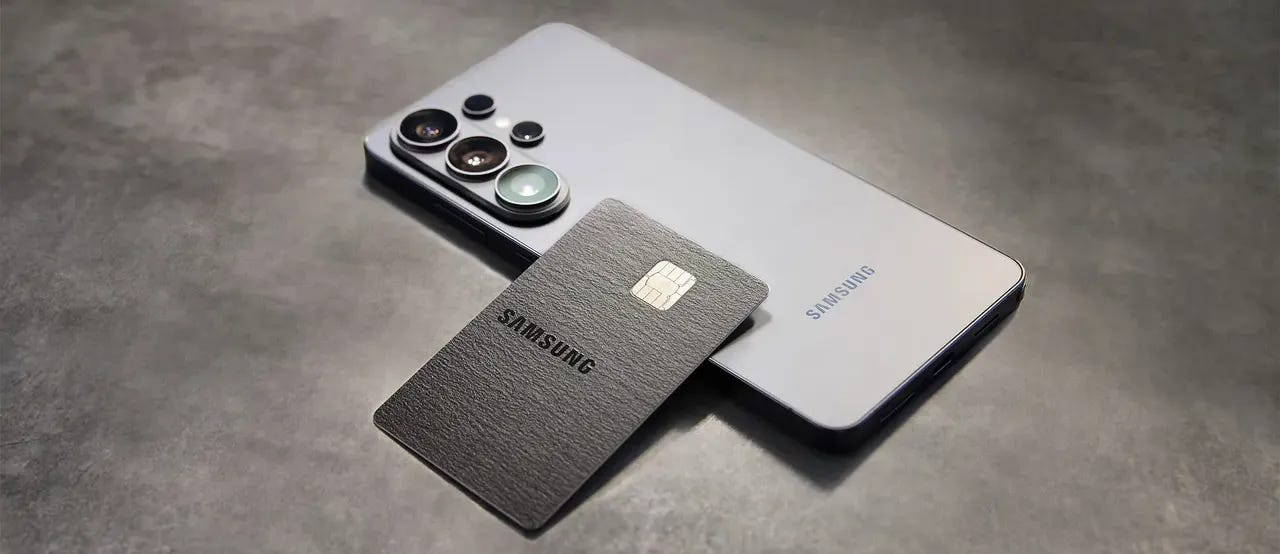
Samsung is getting into the credit card business.
This week the company announced the Samsung Galaxy Card. Its first credit card, issued by Barclays and running on the Visa network (American Banker). Applications opened July 22, right before Samsung’s Galaxy Unpacked event (Wired, CNET).
The card lives natively inside Samsung Wallet. You apply there. You service the account there. You redeem rewards there. You never leave Samsung’s ecosystem.
The number to know: 3% cash back on eligible purchases made through Samsung Wallet, no spend caps. That's a full point above Apple Card's blanket 2% Apple Pay rate. Apple only pays 3% at Apple and a short list of partner merchants (Apple). Samsung pays it on everything in the wallet.

And Barclays is doing something no issuer has done before: extending its servicing APIs all the way into Samsung’s operating system.
“Rather than going to our app or our website, you’re now servicing it within Samsung’s ecosystem completely,” Doug Villone, Barclays’ head of US cards and partnerships, told American Banker.
If the Apple Card comparison feels familiar, it should. We covered the messy end of that program’s first chapter in January, when JPMorgan Chase took over the portfolio from Goldman Sachs at a discount of more than $1 billion (Apple Card’s Next Chapter Starts at JPMorgan).
That’s the story.
Sponsored by Spinwheel

Now here’s our Toaster Take.
Samsung Is Paying Barclays’ Rewards Bill To Handcuff You To Your Phone
It's a retention product wearing a rewards costume.
Start with the number that doesn’t add up: 3% cash back on every purchase made through Samsung Wallet. No spend caps.
That doesn’t work on a lender’s margins. Interchange doesn’t cover it.
Neither company has said who funds the gap. But we don’t think there’s much mystery here. Samsung is likely writing the check.
Look at where the richest rate points. Apple pays 3% at Apple. Samsung pays 5% at Samsung: Samsung.com, the Shop App, its stores (terms).
Same playbook, two points richer. The top of the earn table always aims back at the house.
And once you see the subsidy, the rest of the product snaps into focus.
The physical card works anywhere, at 1%. But the 3% only pays when the card sits in Samsung Wallet. And Samsung Wallet only runs on Samsung devices.
Switch to an iPhone? Your everyday spend drops to 1%.
(Technically the 5% on Samsung.com purchases survives the switch. But you just bought an iPhone. You’re not making many of those.)
The math makes it rational. Every Samsung phone is a $1,000+ sale, followed by years of ecosystem revenue. And Samsung is fighting uphill in the US. Roughly 6 in 10 US smartphones sold are iPhones, and Samsung sits second at well under half of Apple’s share (Counterpoint Research via AppleInsider).
Against that, funding a couple points of cash back on a cardholder’s spend is cheap insurance.
There’s a quieter prize too. And Amazon showed everyone how it works.
A co-brand card doesn’t just drive loyalty inside your store. It shows you every purchase your customer makes outside it. That data is worth a lot to a company deciding what to build, stock, and sell next.
Keep that thought. It’s about to become the whole story.
“First In Wallet” Just Changed Meaning
Card issuers have spent decades fighting to be first in the physical wallet. The card you reach for without thinking.
Our take: that fight is moving. And some lenders haven’t noticed.
The fight that matters now is first in the digital wallet. Because the default card in the wallet is the card your AI agent is going to swipe.
Agentic commerce is early. But it’s not hypothetical.
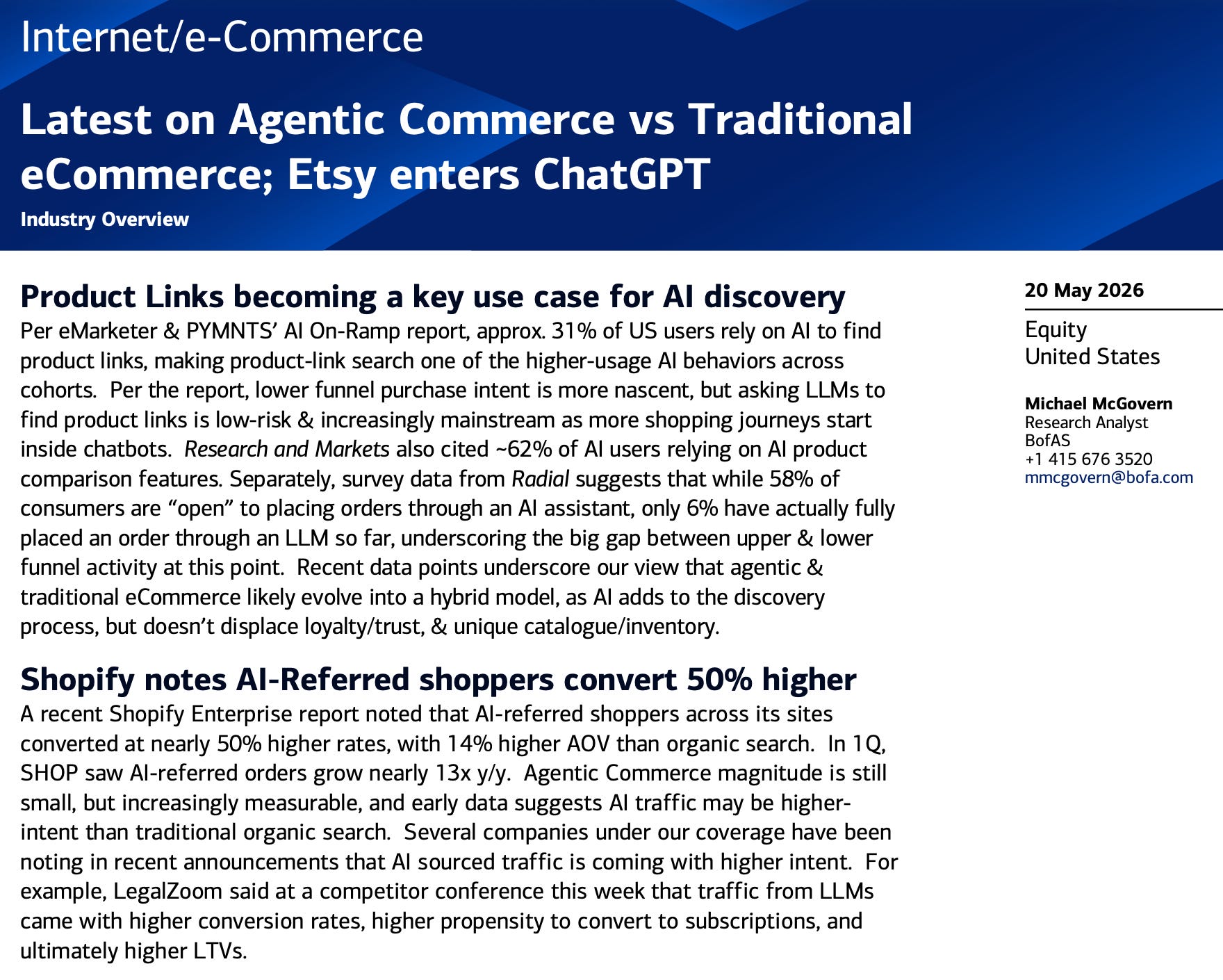
About 31% of US AI users already use AI to find product links. One of the highest-usage AI behaviors across age cohorts. Shopify reports AI-referred shoppers convert at roughly 50% higher rates than organic search, with AI-referred orders up ~13x year over year in Q1. Only 6% of consumers have actually completed a purchase through an LLM so far, so the bottom of the funnel is still nascent. (All per BofA Global Research, “Latest on Agentic Commerce vs Traditional eCommerce”)
But when those purchases happen, the agent isn’t going to deliberate over which of your cards to use.
It will use the default.
Whoever holds that slot gets the transaction.
Chase already owns that position across the Apple ecosystem. As of this week, Barclays owns it across Samsung’s.
Neither bank has framed it this way publicly. We are.
Which brings us to the lesson.
And this part is advice: If you’re a card issuer trying to grow a co-brand business, stop only calling retailers.
The classic playbook is retailers, retailers, retailers. The new call list is technology companies with a vested interest in keeping consumers inside their world.
They’ll do two things a retail partner never could:
Hand you distribution inside a platform people touch every day
Subsidize terms you could never offer on your own economics
Samsung just showed everyone the template.
Our Prediction: There Will Be A Claude Card And A ChatGPT Card
Now we’re going to speculate. None of what follows has been announced by anyone (that we know of). But we’d rather be on record.
Though one thing was announced: on Tuesday, OpenAI seated Nubank founder David Vélez on its board (OpenAI).
We can only speculate why and here’s what got us there.
We asked ourselves which companies fit the profile we just described: technology platforms with daily usage, deep customer context, and a reason to lock users in.
The answer wasn’t another phone maker.
It was the LLMs.
The scale is already there. The Google Search app’s share of daily active users versus AI apps has fallen from 87.5% in January 2025 to 72.5% in June 2026. And ChatGPT did more than $260MM in revenue in June alone (BofA Global Research, “Apple Inc.: F3Q26”.
ChatGPT counts 441MM global mobile daily active users. Claude is at roughly $59MM a month in revenue, growing daily users at 1,200%+ year over year. It’s momentum BofA attributes to “Claude Code and agentic features” (BofA Global Research, “AI Wars: Claude & Gemini momentum continues, with stable Google growth,”).
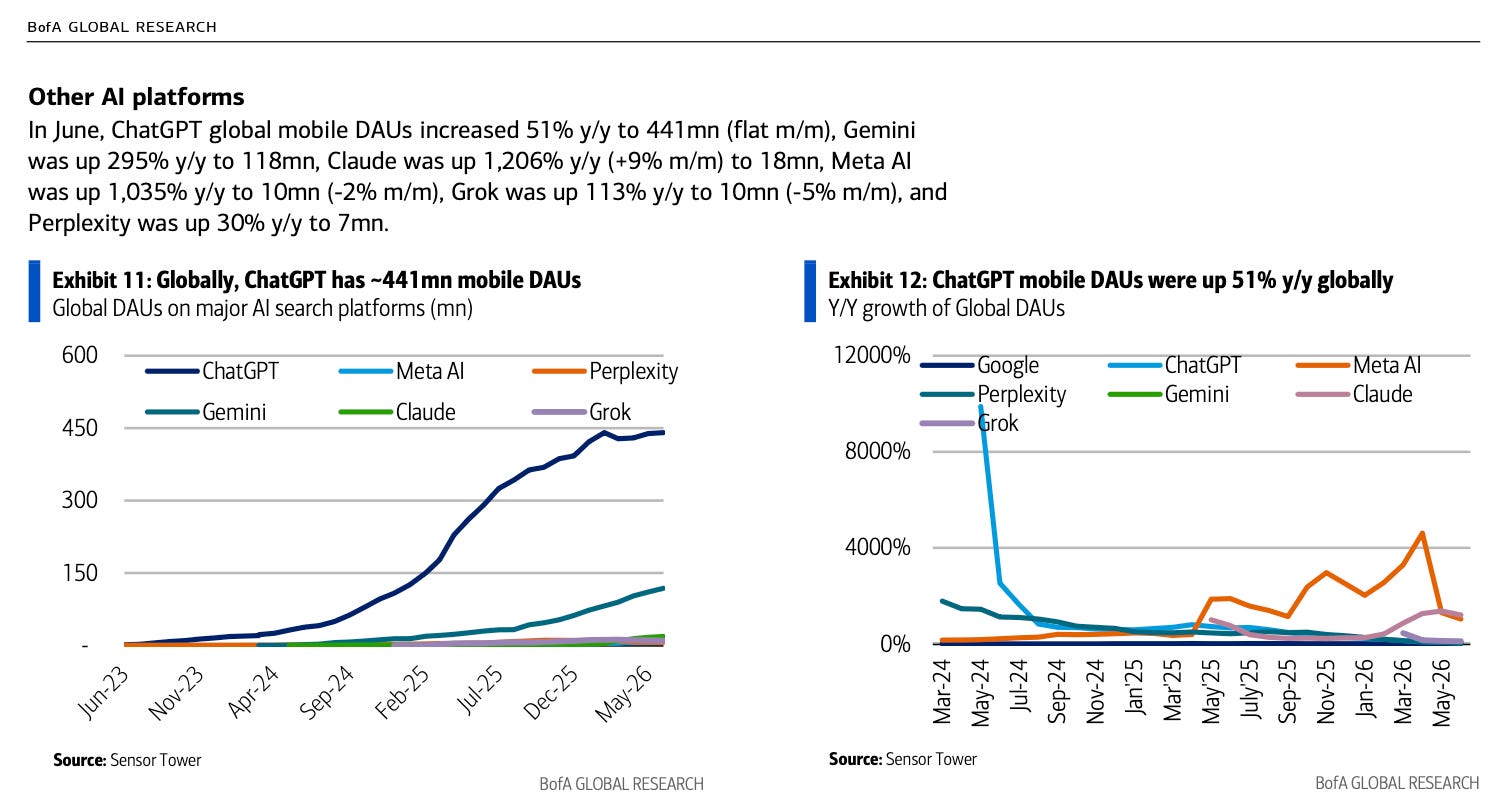
These are daily habits at consumer scale, with real willingness to pay.
A daily habit plus a payment credential is exactly the position Samsung just monetized. And the LLMs are further along the daily-habit curve than Samsung Wallet ever was.
Here’s the thing: the incentive is even stronger than Samsung’s.
Anthropic and OpenAI are in the business of monetizing intelligence. The more context they have on you, the more valuable that intelligence gets. The compounding is the point.
The biggest missing context? What you do offline, away from the chat window.
A card is the window.
Samsung wants your purchase data to sell you more Samsung. An LLM wants it because it makes the core product better.
Picture what that unlocks.
You’ve told Claude you’re saving for a house. Claude also issues your card. One morning it opens with: “You spent $300 at Starbucks last month. Want me to block Starbucks until you hit your goal?”
That’s a hypothetical. But that’s the conversation a card makes possible. No bank’s app has ever come close.
Or take the offer side. You ask about rental cars for a trip. Alamo happens to be a card partner. The answer comes back: “cardholders get 20% off, say yes and it’s booked.”
A daily product with full context doesn’t serve ads. It serves outcomes.
The rewards get interesting too. We pay for Claude Max. Offer us extra usage limits as a card perk and we’d chase it. Hard.
Cash back is a commodity. Model access is a loyalty currency no incumbent issuer can mint.
The privacy question is real, so let’s answer it head-on: will consumers want their AI to know this much?
In finances, we think yes. It’s simply going to be too useful not to.
One more thing nags at us.
Google has owned search and a wallet for over a decade and has never issued a consumer credit card. Its closest attempt, the Plex banking project, was scrapped in 2021 before launch, despite a 400,000-person waitlist (CNBC).
We’re surprised the seat is still empty.
Maybe the LLMs Never Need To Issue A Card
The counterargument is Plaid.
We wrote in May about ChatGPT’s Plaid integration making it a distribution channel for personal finance. Permission your accounts, and the LLM gets the spending intelligence with zero plastic. No bank charter. No credit risk. And the consumer can revoke access anytime.
Why issue a card at all?
Add to that: the LLMs are currently retreating from the transaction, not grabbing it. OpenAI has reportedly pulled back from “Instant Checkout” toward retailer-controlled checkout after finding users research in ChatGPT but buy elsewhere (The Information, as cited in BofA Global Research, “OpenAI may shift Agentic Checkout”).
And Google is monetizing its agentic surfaces through ads rather than commissions (BofA Global Research, “The dog days of AI”).
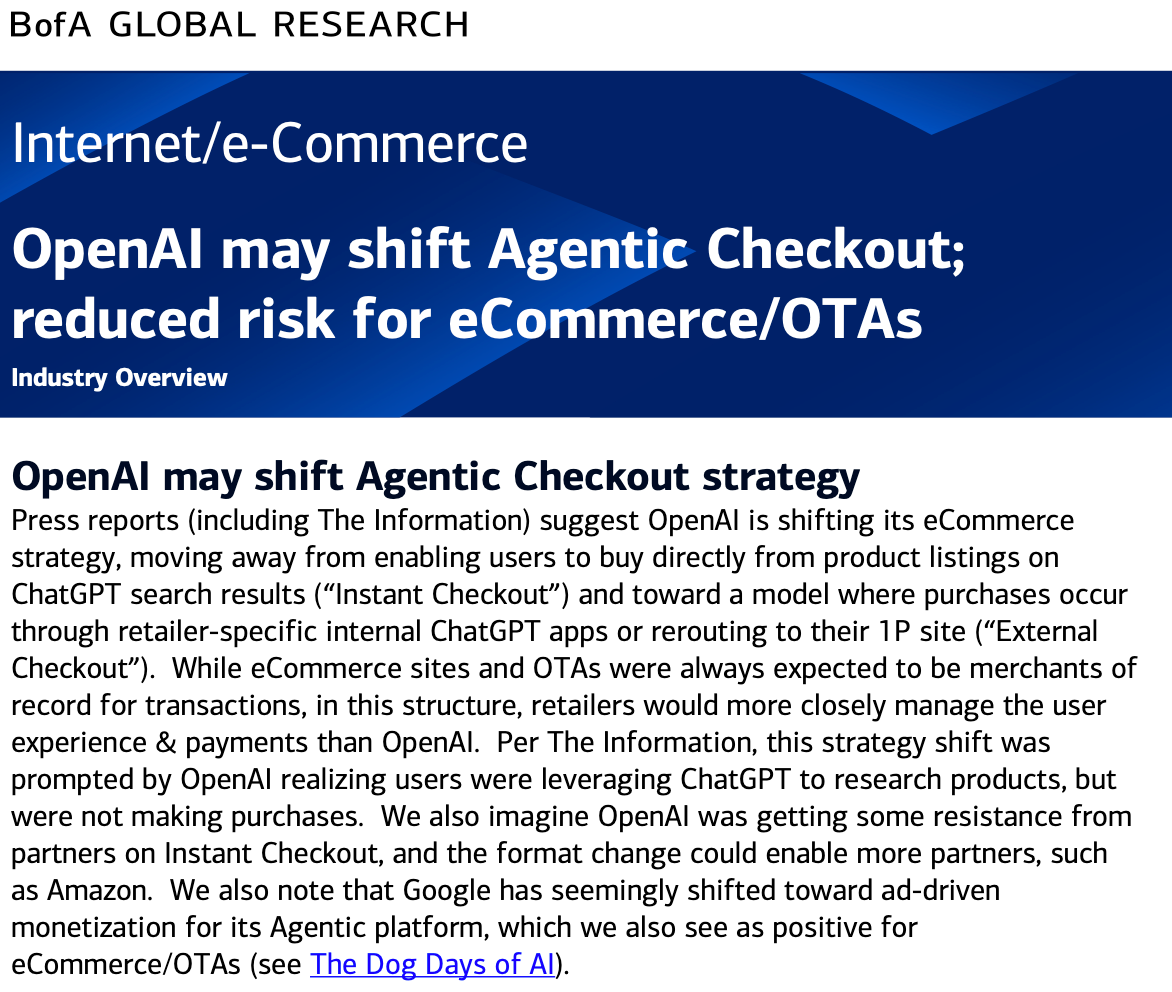
Maybe the LLMs settle in as discovery layers and never touch the payment credential.
Then we argued ourselves back in.
Plaid access is something a user has to grant, account by account. And it can break without warning.
A card is zero friction. One instrument that captures everything, funds its own rewards through interchange, and monetizes through sponsored offers.
And precisely because the LLMs are ceding checkout to retailers, the payment credential is the one durable position left in the stack. Samsung’s logic applies with full force: you issue the plastic because you want the whole picture.
Where we land today: the cards happen.
Ask us again in six months.
A footnote on rails, filed under questions we can’t answer: does a Claude card launch on Visa or Mastercard? Or on stablecoin infrastructure?
Programmable money is the more natural fit for agentic commerce: smart contracts, near-instant settlement. It might be blockchain’s actual consumer use case.
Our guess is boring: launch on traditional rails for acceptance, migrate agentic flows later.
But we don’t know. And neither does anyone else yet.
What Do You Think?
We’d be surprised if Anthropic, OpenAI, and Google haven’t already gamed this out internally.
If you’re working on anything in this space, or you know who is, we want to hear from you. This piece is us thinking out loud, and we’d love to learn more from operators in the space.
Catch you next week,
The Free Toaster Team
P.S.: If you’d like to sponsor or host an event in the consumer lending community in 2026, we’d like to hear from you. Reply to this email or write us at info@thefreetoaster.com.