

Hey Toaster Readers,
This week is sponsored by our friends at Bulldog Media Group.
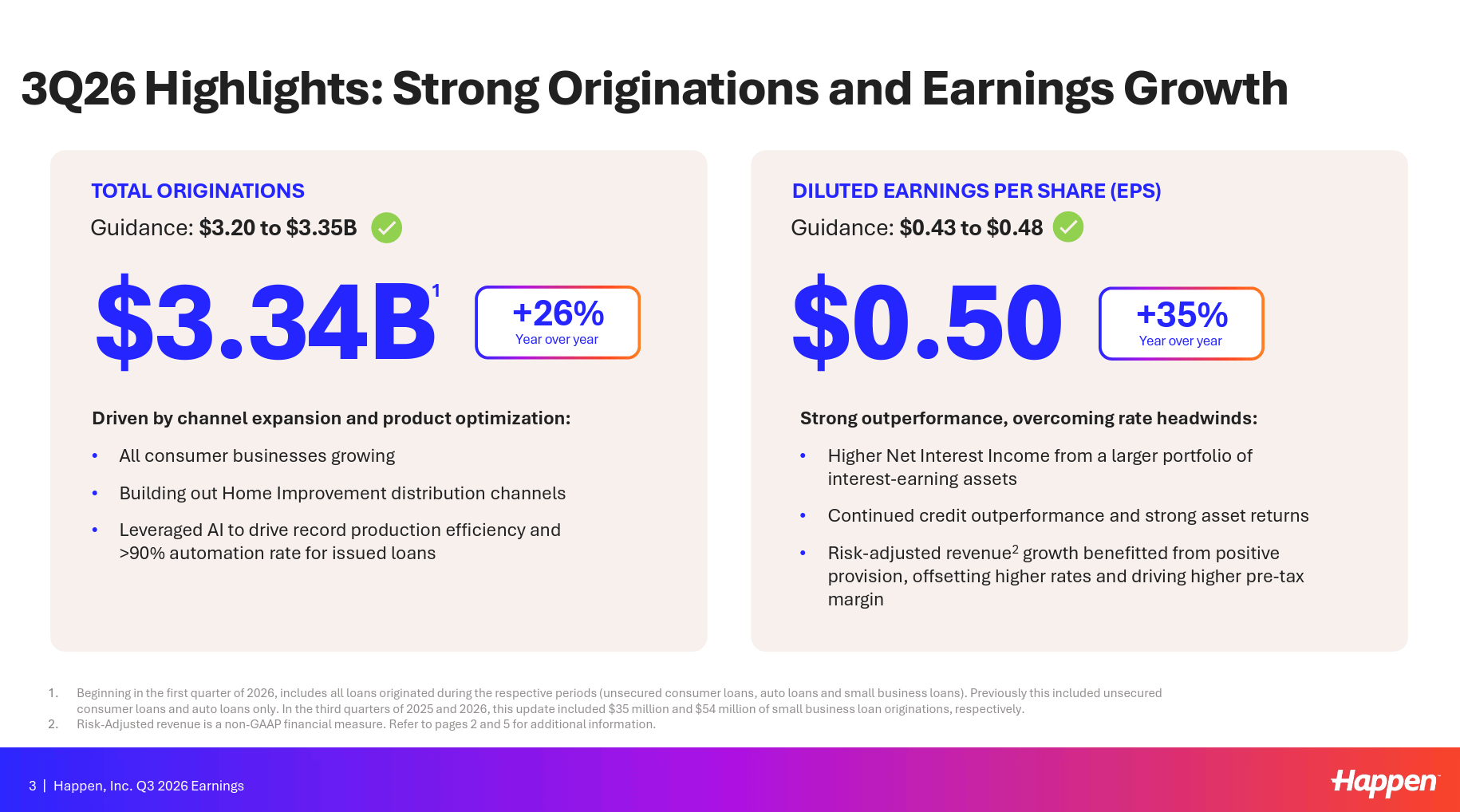
On October 28, Happen Bank announced Q3 earnings. Originations came in at $3.34 billion, up 26% YoY. Pre-tax income was a record $76.8 million.
Below are the nuggets we think a marketer at a consumer lender or digital bank would care about. This was Happen’s first full quarter under the new name, and the call doubled as a case study for the impact of a rebrand.
We transcribed the whole call ourselves, so quotes link to the transcript or the source document.
Let’s get toasting!
- Carlos Caro & Nick Madrid, Founders of The Free Toaster
PS: We’re actively planning our Spring 2027 Customer Acquisition Summit for Lending event on April 7-8th in NYC! If you’re interested in sponsoring that event, please reply to this email or write us at info@thefreetoaster.com.
Summarizing Happen Bank’s Q3
From the Q3 earnings presentation (quarter ended September 30th, reported October 28th):
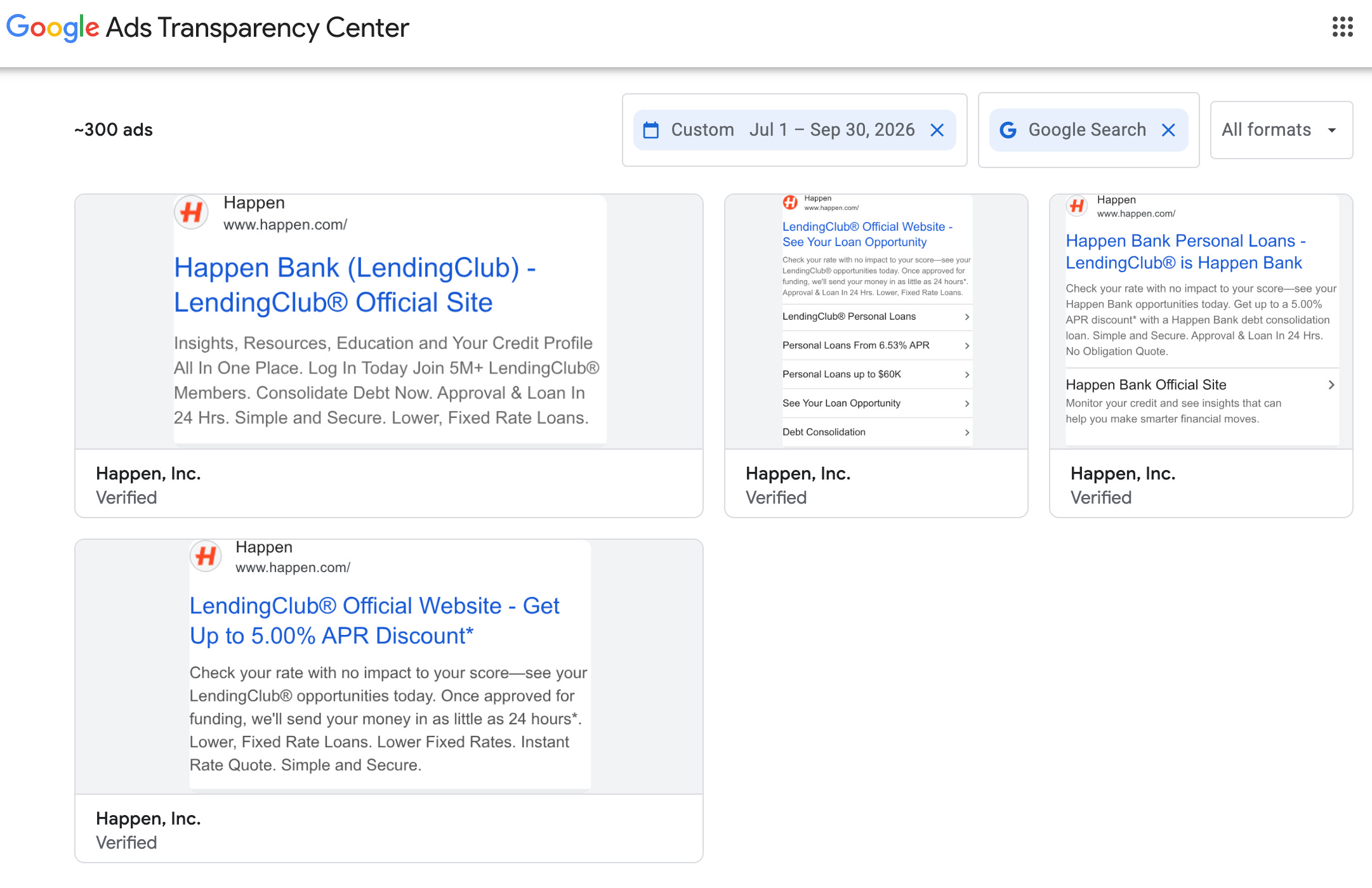
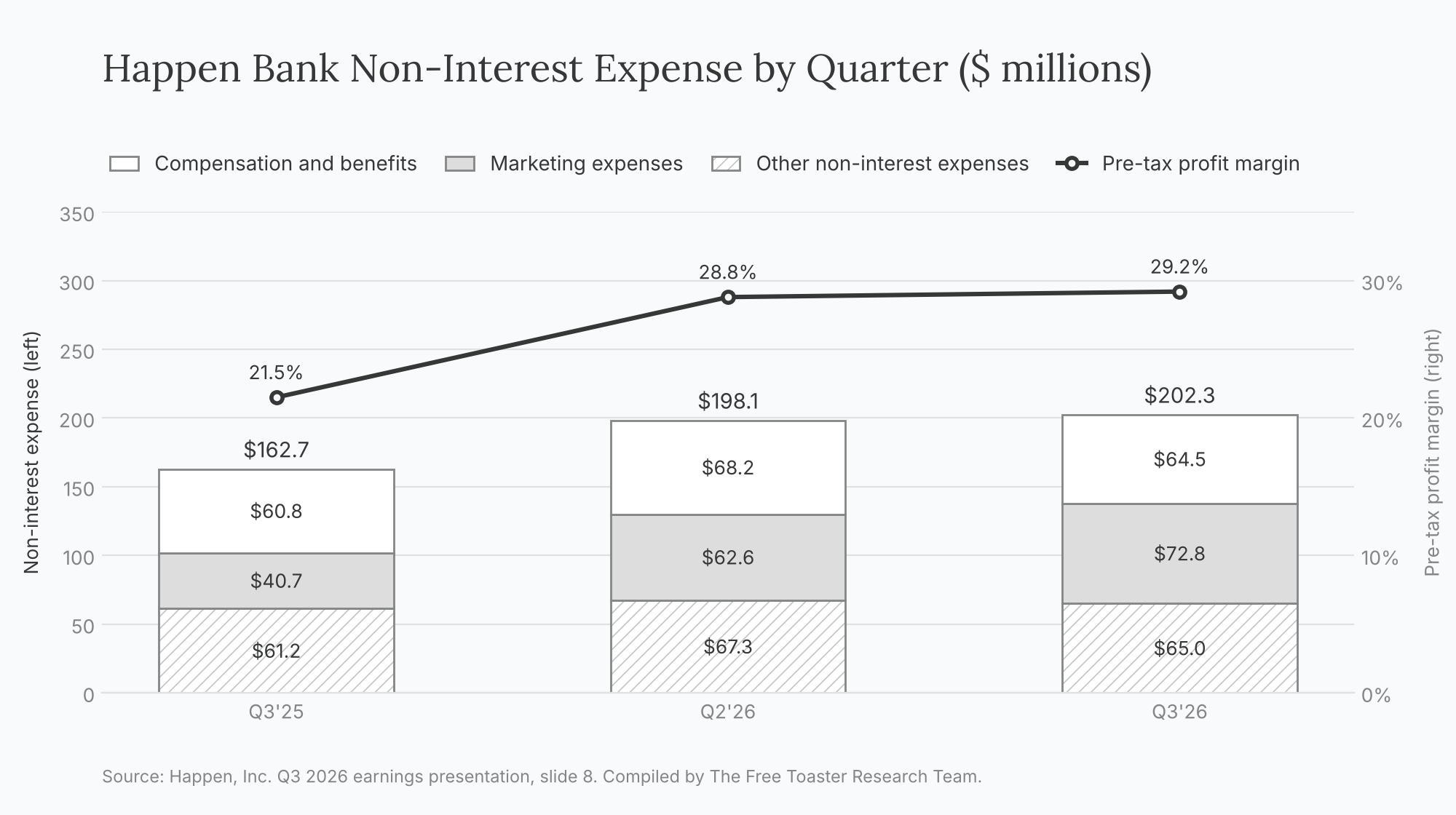
The rebrand pushed marketing to 2.2% of originations (up from 2.0%)
CFO Drew LaBenne spoke to the increase in marketing spend:
“Marketing expense was 2.2% of originations, up from 2% in the second quarter, reflecting an increase associated with our successful rebrand. We expect that ratio to modestly improve in the fourth quarter as the rebrand impact normalizes, offset by the effects of seasonality.” (Drew LaBenne, Q3 earnings call)
CEO Scott Sanborn added context on the impact of the rebrand:
“So the big driver of the step-up last quarter was really the rebrand, both the costs of making that transition, covering thousands of emails and the website and all the rest, but also the friction associated with it. Things like, you lose authority in your domain in areas like organic search, which is a low-cost channel. You have some friction with consumers who had passwords saved, connected to the old domain in their browsers, that don’t all render when they visit a new domain.” (Scott Sanborn, Q3 earnings call)
You lose authority in your domain in areas like organic search.
That sounds like Happen lost low-cost (free) traffic early in the quarter, and paid media filled the hole.
The dollars, side by side from the press release:
Marketing expense: $72.8M in Q3, up from $62.6M in Q2 and $40.7M a year ago
Marketing as a share of originations: 2.18% in Q3, 1.99% in Q2, 1.53% a year ago
Originations: $3.34B, up 6% from Q2 and 26% from a year ago
One note on the 79% year-over-year jump in marketing spend: the earnings presentation attributes it to “volume growth, rebrand-related spend, and full recognition of marketing costs under fair value accounting.”
Since January, Happen books all marketing cost the day a loan is issued instead of spreading part of it over the life of the loan, so the year-ago figure is on a different basis (slide 13, Q3 Earnings Presentation PDF). The quarter-over-quarter move (2.0% to 2.2%) is the cleaner read, and Sanborn called the rebrand “the big driver” of it.
(Sidebar: If you’re curious why lenders like Happen Bank are moving from CECL to Fair Value accounting, you might enjoy this piece.)
Why you should care: If a rebrand or a domain change is anywhere on your roadmap, you now have a benchmark on cost. Budget for lost organic search authority, broken saved logins for your best repeat customers, and paid spend increases to offset. Happen is a lender built on direct response and its marketing spend increased 20 bps as a share of originations.
(PS: If you’d like to hear how Happen Bank planned for and implemented their rebrand, check out our interview with Happen Bank’s Mark Elliot on The Free Toaster Podcast).
Sponsored by Bulldog Media Group
Reach the Borrowers Others Miss
Bulldog Media Group specializes in connecting consumer lenders with less than perfect borrowers — a massive, underserved market that requires precision targeting to get right. With 25 years of financial services marketing experience, they deliver qualified leads through affiliate marketing, targeted email, and data-driven acquisition strategies built for this exact audience.
The budget comes back to 2% to 2.1% of issued volume, and new channels will run less efficient until they’re tuned
Jefferies also asked for 2027 guidance on marketing spend. Sanborn responded:
“As we look ahead, we would expect to begin to come back down towards our historical run rate, which is roughly in the 2% of issued volume. It’s obviously more efficient in Q2 and Q3 than it is in Q4 and Q1, but call it 2% to 2.1% as a range you can count on.” (Scott Sanborn, Q3 earnings call)
Then the part we found more interesting:
“I’d also note, we are expanding the marketing channels. We started that this year and have seen good success and traction. But with the new brand in place, we are leaning into broader-based, less direct-response channels, things like paid social, where, for example, we’re now advertising our LevelUp savings product and seeing positive initial results there. So those new channels are a little less efficient until we get them tuned.” (Scott Sanborn, Q3 earnings call)
A little less efficient until we get them tuned.
That makes total sense to us as lenders typically see higher CACs in paid social than channels like Direct Mail & Affiliates. It’ll be interesting to see if they’ll share how the relative CACs across those channels compare - lenders rarely provide that level of granularity in their public filings.
Sanborn also shared:
“Searches for Happen Bank are already more than two times those for LendingClub. Existing members have made the switch, and prospects are responding to the new brand creative at higher rates” (Q3 earnings call).
Why you should care: Two percent of issued volume is now a public benchmark for marketing cost at a lender originating about $3.3B a quarter across personal loans, auto refinance, purchase finance and home improvement. If you issue personal loan, compare your marketing spend against it. And if you’ve been fighting to get paid social or display into your channel mix, you now have a public lender on the record investing there, accepting lower efficiency up front, and building the attribution models to prove it out.
Repeat borrowers are “borderline free,” and the deposit products are what bring them back
One line from the Q&A illustrates why a rebrand is so hard.
Sanborn, on the customers who got stuck on saved passwords:
“Our repeat customers, which are obviously lower-cost, borderline free customer acquisition, had some friction early in the quarter, and we made that up with paid advertising.” (Q3 earnings call)
Borderline free customer acquisition. But, volumes can take a hit when the customer experience isn’t quite the same post-rebrand.
Then the prepared remarks put numbers on what keeps those customers around:
“Among borrowers who have paid off their loans, those with either a deposit account or Debt IQ are two to three times more likely to return to us than those who only had a loan. The number of active borrowers with a deposit account tripled in the past year, thanks in no small part to our 2% cash back for on-time loan payments made through LevelUp checking. One in five LevelUp savings accounts are being opened by borrowers who, after paying off their loan, build savings of $18,000 to $20,000, about equal to the credit card debt they originally came to us to consolidate.” (Scott Sanborn, Q3 earnings call)
It seems logical to us that multi-product customers have higher retention rates and repeat loan usage. It’s interesting to see the Happen Bank is dialed into measuring that dynamic.
The updated Meet Happen deck adds color: about 50% of loan volume comes from repeat borrowers, and the company indexes lifetime value per member at 2.6x for a two-loan member and 6.5x for a multi-loan member versus a single loan, citing “lower marketing costs” and better credit as the reasons. The app is doing the same job. Per the call: “A majority of our customer interactions now come through the app, and loan issuance through the app has doubled year over year.”
We wrote in July that Happen was running Chime’s playbook in reverse: acquire through lending, retain through deposits. The Q3 earnings deck puts concrete numbers against it.
Why you should care: If half your volume came from repeat customers at near-zero acquisition cost, your blended CAC would look very different from your paid CAC. Happen’s version of the loyalty program is a 2% cash-back checking account and other features they’ve designed for their “Motivated Middle” segment. If you’re a lender without a deposit product, the question is what you can give a paid-off borrower that gets them to log in between loans.
Operations headcount is down 20% on 26% more volume, and the savings are going to the brand and the product roadmap
Sanborn hit the headline directly:
“Together with our other AI tools, we supported 26% higher loan volume this quarter with 20% lower operations headcount and delivered another quarter of record efficiency.” (Scott Sanborn, Q3 earnings call)
LaBenne described how Happen Bank will take advantage of those efficiencies:
These efficiencies give us room to reinvest in our new product roadmap and brand while maintaining expense discipline.” (Drew LaBenne, Q3 earnings call)
And when Piper Sandler asked about compensation, Sanborn added: “If we were at last year’s efficiency, we would have had over 200 additional heads in operations to process the volume” (Q3 earnings call). Compensation and benefits came in at $64.5M, down $3.7M from Q2, while marketing rose $10.2M in the same quarter (press release).
They believe they saved over 200 additional heads!
How’d they do it?
Penny, the AI member service agent, “is resolving 30% more calls than our legacy system, which means faster response times and higher member satisfaction.” Call QA is automated at 100% coverage. And the company said AI usage roughly doubled between July and September while total AI spend went down.
Why you should care: When your CFO asks where the money for brand and new channels comes from, Happen just gave you the answer a public company is using: automate the operations that scale with volume, then move the savings into acquisition, brand, and product. Sanborn also said the company is now choosing not to backfill some roles “because we can cover the gap with AI.” We expect to see more companies plow ops costs savings into growth and marketing.
Some quick hits before we wrap up
Happen wants to be discovered by AI agents. Sanborn: “AI agents are coming to banking, and we believe that we stand to benefit and we plan to be ready.” And: “we’re making the investments now to be both highly visible and responsibly accessible to agents when the time comes” (Q3 earnings call). We’ve covered what happens when consumers delegate financial decisions to agents; this is the first lender we’ve heard put being visible to agents on an earnings call.
Home improvement did $100M in its first full quarter, and the customer is a step up. Sanborn said these borrowers run “an extra 20 or 30 or even 40 points of FICO versus the core direct-to-consumer business” and about $30,000 to $40,000 higher in income, with part of the cost “covered by the MDF fee provided via the contractor or the partnership” (the fee the merchant pays to offer financing). Average draw so far: “roughly $10,000.” HappenConnect, the embedded financing platform, cut partner onboarding time by 60%, and Sanborn said the embedded business (home improvement plus purchase finance) “should be getting out of the single digits into the low double digits as a percent of our originations” over the course of next year (Q3 earnings call).
Auto refinance volume pulls back, and offers get repriced. LaBenne on auto refi in a rising rate environment: “it was already a thinner-margin business, lower losses but thinner margin, for us. So that’s something we’ll pull back on.” On pricing: “we’ll be raising prices where we can to consumers” (Q3 earnings call). Q4 originations guidance is $3.1B to $3.2B, down from Q3’s $3.34B, which LaBenne attributed to “typical fourth quarter seasonality and the transition to higher interest rates as we increase borrower pricing” (Q3 earnings call).
On the fintechs chasing bank charters. Asked by a retail investor, Sanborn said the fintechs pursuing charters are “validating the idea that we pursued six years ago now” and noted that with conditional approvals, “most of these banks are not yet operating as banks. They should be hitting the market throughout the course of next year” (Q3 earnings call). We tracked the bank charter applicants when Klarna filed in July.
Catch you next week,
Founders of The Free Toaster
P.S.: If you’d like to sponsor or host an event in the consumer lending community in 2027, we’d like to hear from you. Reply to this email or write us at info@thefreetoaster.com.