

Hey Toaster Readers,
This week is sponsored by our friends at Fintel Connect.
Fiserv and Affirm are teaming up to bring buy now, pay later directly to standard debit accounts, potentially changing the game for thousands of financial institutions. But the regulatory heat is rising elsewhere as New York picks a fight with the tech world over a new bill that would officially label earned wage access as a loan. We are also tracking Mastercard’s new AI Agent Suite and Nubank’s major move to establish a national bank right here in the U.S.
Lots to break down. Let’s get toasting!
— Carlos Caro, Founder at New Market Growth
— Nick Madrid, Co-Founder of The Free Toaster and Uncovered Media
PS: To support us, please share our Newsletter in your internal Slack channels!

Fiserv and Affirm Join Forces to Bring Flexible Payments to Debit
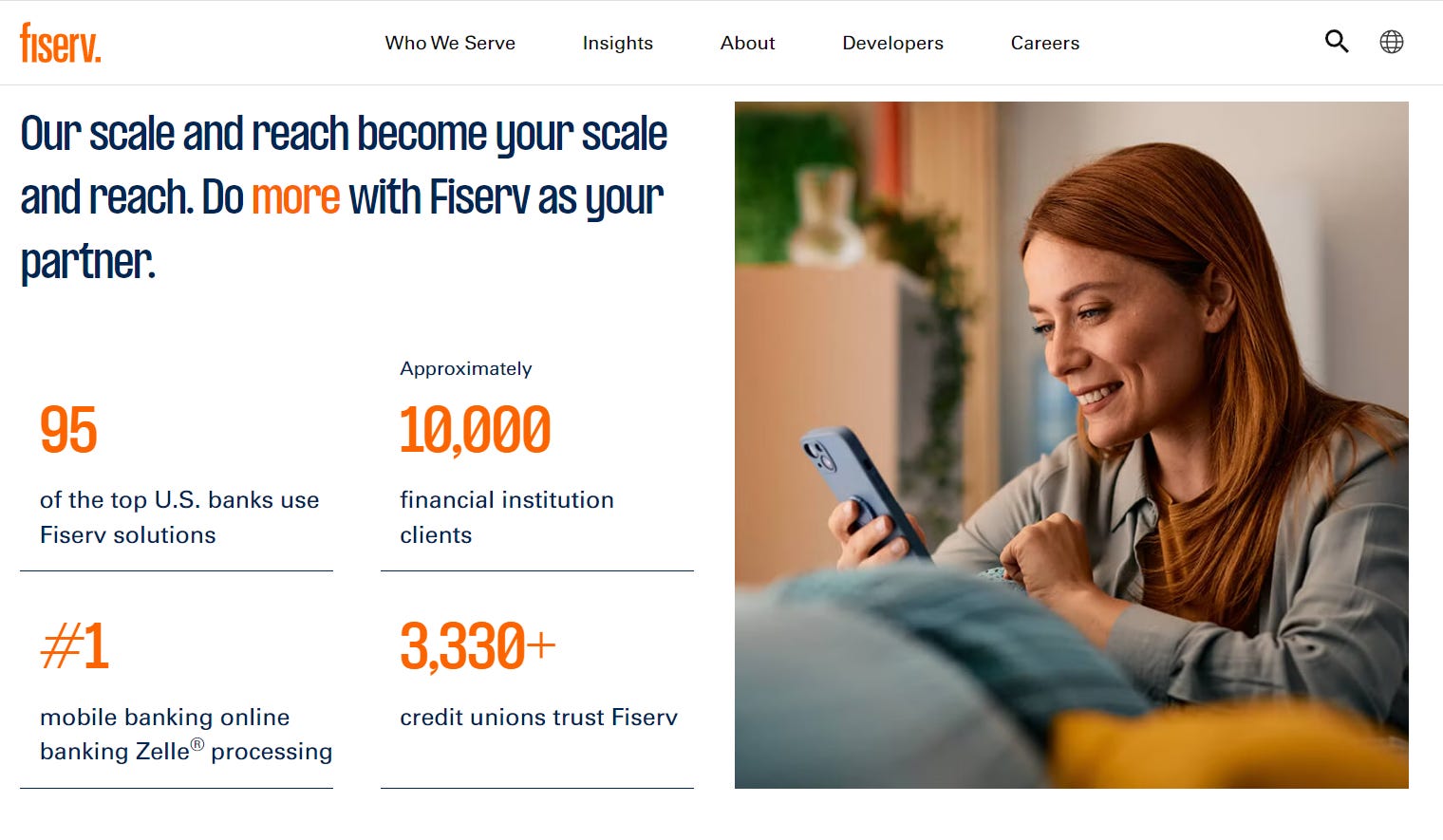
Fiserv is partnering with Affirm to add installment payment options to standard debit cards. As a major provider of financial technology and payment processing, Fiserv offers the backend infrastructure, while Affirm provides the underwriting and merchant network for these pay-over-time services. This collaboration allows thousands of financial institutions to offer buy now, pay later features through their existing mobile apps without developing the lending technology themselves. Customers can split eligible purchases into fixed payments at nearly 420,000 retailers where their cards are already accepted. The move helps banks keep more transactions within their own ecosystems and encourages users to keep these cards at the top of their wallets. By integrating these features directly into a debit card, banks can offer the predictability of a repayment schedule alongside the simplicity of a checking account. (Affirm)
Toaster’s Take
The U.S. BNPL was in the $100B+ range in 2024-2025. 90MM+ Americans have made purchases with BNPL products. During the holidays of 2025, U.S. shoppers spent $10.1B between early November and Cyber Monday using BNPL. You hear anecdotes (many of them true), of folks using BNPL to finance lunches or dinners. Fintech has done a great job reducing friction in banking and lending, and increasing access to many underserved populations. But, at some point, removing friction goes too far and we wonder whether making it easy for consumers to put a debit transaction on a BNPL plan is something we'll ultimately regret as an industry. We're hoping that this can be a good thing for lenders and consumers (it could be, if executed well), but can't help but worry about how this might pan out.


The Free Toaster Podcast takes the biggest fintech, credit, and payments stories of the week and breaks down what they mean for growth, distribution, and product strategy. If you read the newsletter, this is the conversation behind it.
Listen on Apple Podcasts, Spotify, Substack, or wherever you get your podcasts.
Be sure to check out out our latest pod!
(And if you have a strong opinion on anything in today’s Edition and would like to be on the show - we record at 12pm ET on Feb 5th - let us know!)
New York State Introduces Bill Deeming EWA a Loan

New York lawmakers are picking a fight with the tech world by introducing the STOP Act, a bill that would officially label earned wage access (EWA) as a loan. Senator Samra Brouk and Assemblymember Steven Raga want to treat these paycheck advance apps, which let workers access earned money before payday, as traditional credit subject to the state’s 16% interest rate cap. This means every voluntary tip or subscription fee would be legally classified as a finance charge, a move intended to stop borrowers from getting swept into what Jose Bedoy called an “obfuscated cycle of debt.” While community credit unions are cheering for a more financially just system, the American Fintech Council is firing back, calling the bill an “out of touch” attempt to strip New Yorkers of helpful financial tools. The drama creates a massive patchwork compliance challenge for the industry, especially since federal laws might eventually swoop in to stop states from calling these products loans at all. It turns out, whether you’re a clever delivery driver or a big tech firm, defining what counts as a loan is becoming a very expensive game of semantics. (American Banker)
Whitehouse, Warren, Merkley, Reed Introduce Bill to Empower States to Protect Americans from High Credit Card Interest Rates
Senators Sheldon Whitehouse and Elizabeth Warren just teamed up with a crew of lawmakers to reintroduce a bill that could finally give states the power to cap interest rates on consumer loans. The U.S. Senate is looking to dismantle a 1978 Supreme Court ruling that let big banks ignore local rules as long as they were headquartered in states with zero protections. This move aims to tackle a record $1.23 trillion mountain of credit card debt where average rates are currently climbing to nearly 22 percent. Even though the Federal Reserve Bank of New York reports that families are drowning in these costs, states currently remain powerless to stop out-of-state lenders from charging whatever they want. The bill, dubbed the Empowering States’ Rights to Protect Consumers Act, would level the playing field so local credit unions don't have to compete with astronomically high rates from national giants. If this passes, your home state might actually get to decide if a 35% interest rate is too high or not. (White House)
Santander to Acquire Webster Bank for $12.2 Billion
Banco Santander recently announced a $12.2 billion agreement to acquire Webster Bank, a move that positions the Spanish financial group as a top-ten retail and commercial lender in the U.S. by assets. As a global financial services platform, Banco Santander is folding in a diversified bank with a concentrated deposit base in the Northeast to increase its American scale. The group expects the deal to help reach an 18% return on tangible equity in the U.S. by 2028. This transaction is projected to provide 7 to 8% earnings accretion along with $800 million in annual cost synergies by the end of 2028.
Industry analysis from Stuart Cook on LinkedIn highlights that Webster Bank sold at twice its tangible book value, which represents a 9% premium over its previous all-time high. It is interesting to consider why an $80 billion bank with stable credit and management chose to sell while in a strong position. This might suggest that the board sees a shift in industry math or that the required timeline for tech and AI updates has shortened to a point where standing alone is less viable. While Banco Santander aims for a sub-40% efficiency ratio, other midsize boards have to decide if they possess a sustainable competitive advantage or if recent earnings growth is just a temporary result of a better yield curve. (Santander)
Want To Reach Our Readers In Person?
The Free Toaster is betting big on live events in 2026.
If you’d like to sponsor or host an event in the consumer lending community in 2026, we’d like to hear from you. Think coffee meetups, lunches, dinners, 1-day events, golf outings, wine tastings.
Our events team can help you bring it to life. Contact amanda@thefreetoaster.com for more information.

LendingClub Says 60% of LevelUp Checking Customers Are Also Borrowers
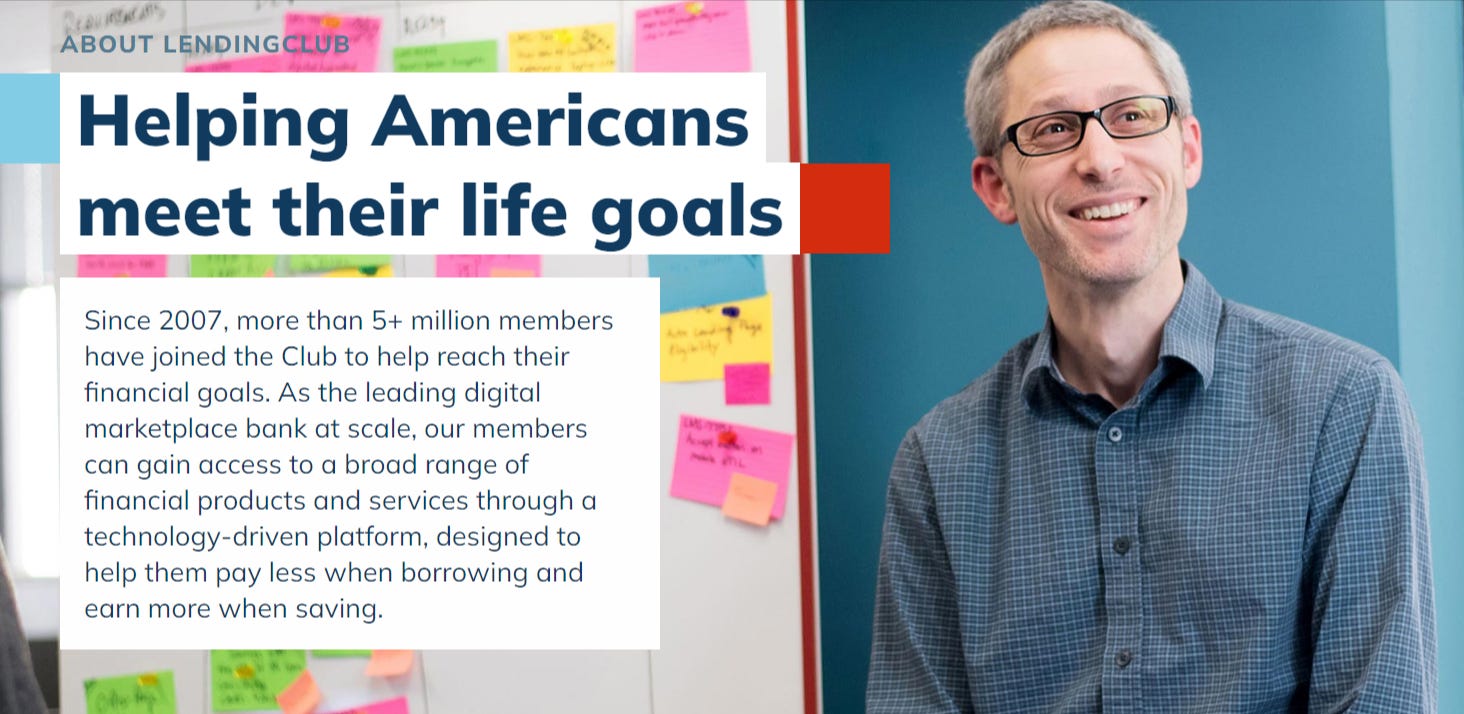
LendingClub definitely found its groove this quarter, proving that being a digital marketplace bank is more than just a fancy title for the online personal loan and banking provider. They posted a sharp increase in activity with loan originations jumping 40% year over year to $2.6 billion, mostly because their new LevelUp products are acting like a magnet for customers. It turns out that 60% of new checking users are also borrowers, and those who finish paying off their loans are sticking around to build a financial cushion in savings. While the company is cruising with a net interest margin that rose to 6%, investors acted a bit grumpy, sending the stock down 7% after hours due to concerns over higher marketing spend. Still, the team is doubling down on growth for 2026, betting that better modeling and more ads will keep the momentum soaring despite the market's jitters. It’s a classic case of spending money to make money, and if the 20% to 30% boost in monthly logins is any indication, customers are actually having some fun with their finances. (PYMNTS)
Experian Acquires Own Up to Expand Mortgage Access and Consumer Home Loans in the Experian Marketplace
Experian, a global data and technology company that provides credit reporting and analytical tools, has entered a definitive agreement to acquire Own Up, an AI-powered mortgage shopping platform. This acquisition integrates expert homebuying guidance and a network of over 40 lenders directly into the Experian marketplace. Because landing an affordable home loan has become increasingly complex for many Americans, this move helps ensure consumers do not overpay for their mortgages. Own Up provides a licensed, tech-enabled service that allows shoppers to receive personalized data and move toward preapproval or a rate lock without leaving the platform. By playing a more direct role in the mortgage journey, Experian reaches consumers during a critical life stage when they feel motivated to act on their financial health. The company aims to act as a financial resource by offering personalized mortgage options alongside its existing suite of credit tools. This deal combines Experian’s data scale with Own Up’s technology to change the homebuying experience for its members. (Business Wire)
Nu Secures Approval to Establish US National Bank

Nu obtained conditional approval from the OCC to establish a national bank in the United States. As a digital financial services platform serving 127 million customers across Brazil, Mexico, and Colombia, Nu (also known as Nubank) aims to export its mobile-only banking model to the American market. Co-founder Cristina Junqueira moved to the U.S. to lead the new entity while Roberto Campos Neto, the former President of the Central Bank of Brazil, joins as Chairman. The company reported $4.2 billion in revenue for Q3 2025, which represents a 39% increase year-over-year. To finalize the charter, Nu must satisfy federal requirements and fully capitalize the bank within the next year. It plans to open the bank within 18 months and has already identified office locations in Miami and San Francisco. While the company is focusing on its existing Latin American hubs, this move signals a major attempt to see if its specific brand of digital banking translates to the U.S. regulatory environment. (Business Wire)
Immigrant-Focused Banking App Seis to Close Down

Seis is officially winding down operations, proving that even strong user engagement cannot always overcome shifting market trends. The San Francisco-based neobanking startup, which provides a Spanish-language banking app and debit cards for U.S. immigrants, announced its closure this week. Despite a "substantial" start where the company opened 500,000 accounts and reached $10 million in annualized revenue in just 16 months, CEO Trevor McKendrick cited changing immigration patterns as the reason for the decline in demand. The company managed a significant feat by reaching $500 million in annual debit card spend, yet the broader environment forced a strategic retreat. Seis will now spend the next few months closing out its business to protect its banking partners and users. McKendrick noted that while running the business was a personal highlight, he is committed to finishing the journey compliance first. (Fintech Futures)
Insigneo Partners with Karta to Launch Premium Charge Card for International Clients

Insigneo, a wealth management firm with $32 billion in supported assets, partnered with fintech company Karta to launch a charge card for high-net-worth individuals with U.S. based assets. Karta operates a premium card platform designed for people who move frequently between countries but keep their holdings in U.S. brokerage or banking institutions. This partnership targets a specific market of international clients who often find standard credit offerings insufficient for their cross-border needs. The card features no foreign transaction fees and includes access to over 1,300 airport lounges. Approved users receive digital access immediately through mobile wallets like Apple Pay and Google Pay. To handle the complexities of international travel, the service provides 24/7 concierge support through WhatsApp. This move allows Insigneo to expand beyond traditional investments and offer a broader range of financial tools for their clients’ daily spending. (Business Wire)
Avelo Taps Cardless for U.S. Airline’s First Next-Gen Loyalty Card
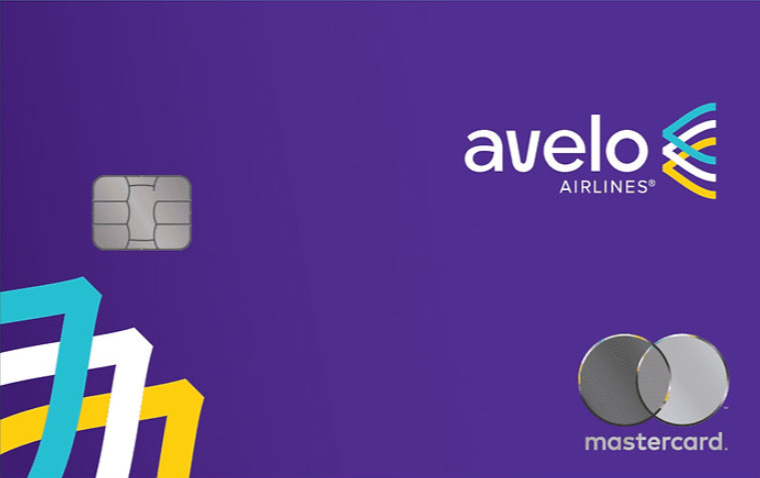
Avelo Airlines, a Houston-based carrier focused on low-cost flights and operational reliability, launched a new World Elite Mastercard in partnership with Cardless. While most major airlines maintain long-standing partnerships with traditional banks, Avelo Airlines is using a digital-first platform to manage its credit card infrastructure. This setup allows the airline to track spending in real time and use data to adjust its rewards programs. Cardless, a financial technology company that builds custom credit card products, provides the backend tech that integrates directly into the airline's app. Avelo Airlines expects this move to drive higher engagement, noting that other cards on this platform saw a "400% year-over-year" increase in transactions. Cardholders receive 5% back in Avelo Cash on flight purchases along with benefits like priority boarding and a free carry-on bag. CEO Andrew Levy suggests that moving away from legacy bank systems allows for more flexibility in how they reward customers. (Avelo)
Turkish Founder on Forbes 2025 List Faces 52 Years in Us for Alleged $7 Million Fraud

Gokce Guven, the 26-year-old founder of Kalder Inc., now faces federal charges for allegedly defrauding investors of $7 million. As a fintech-marketing platform, Kalder Inc. claims to help brands create and monetize rewards programs, but prosecutors say Guven built the business on fabricated financial documents and false partnership claims. She reportedly maintained two sets of books, showing venture capitalists inflated revenue while an outside accounting firm kept an accurate, internal version. Beyond the financial discrepancies, Guven allegedly forged signatures from executives to obtain an O-1A visa, which the government reserves for individuals of extraordinary ability. Despite these allegations, she appeared on the Forbes 30 Under 30 list in early 2025, which reported the company had a $35 million valuation. Guven now faces a potential maximum sentence of over 50 years in prison if convicted on all counts of fraud and identity theft. Her legal case will proceed in the Southern District of New York under Judge Lewis A. Kaplan. (Turkiye Today) (Justice.gov)
Please support our Newsletter by recommending us to one of your colleagues!
And, please check out our sponsors:
Need an affiliate marketing platform/network? Chat with Fintel Connect
Need to improve application page conversions? Chat with Spinwheel
Need help with performance marketing? Chat with Bulldog Media Group
Need to accelerate your affiliate marketing? Chat with New Market Growth
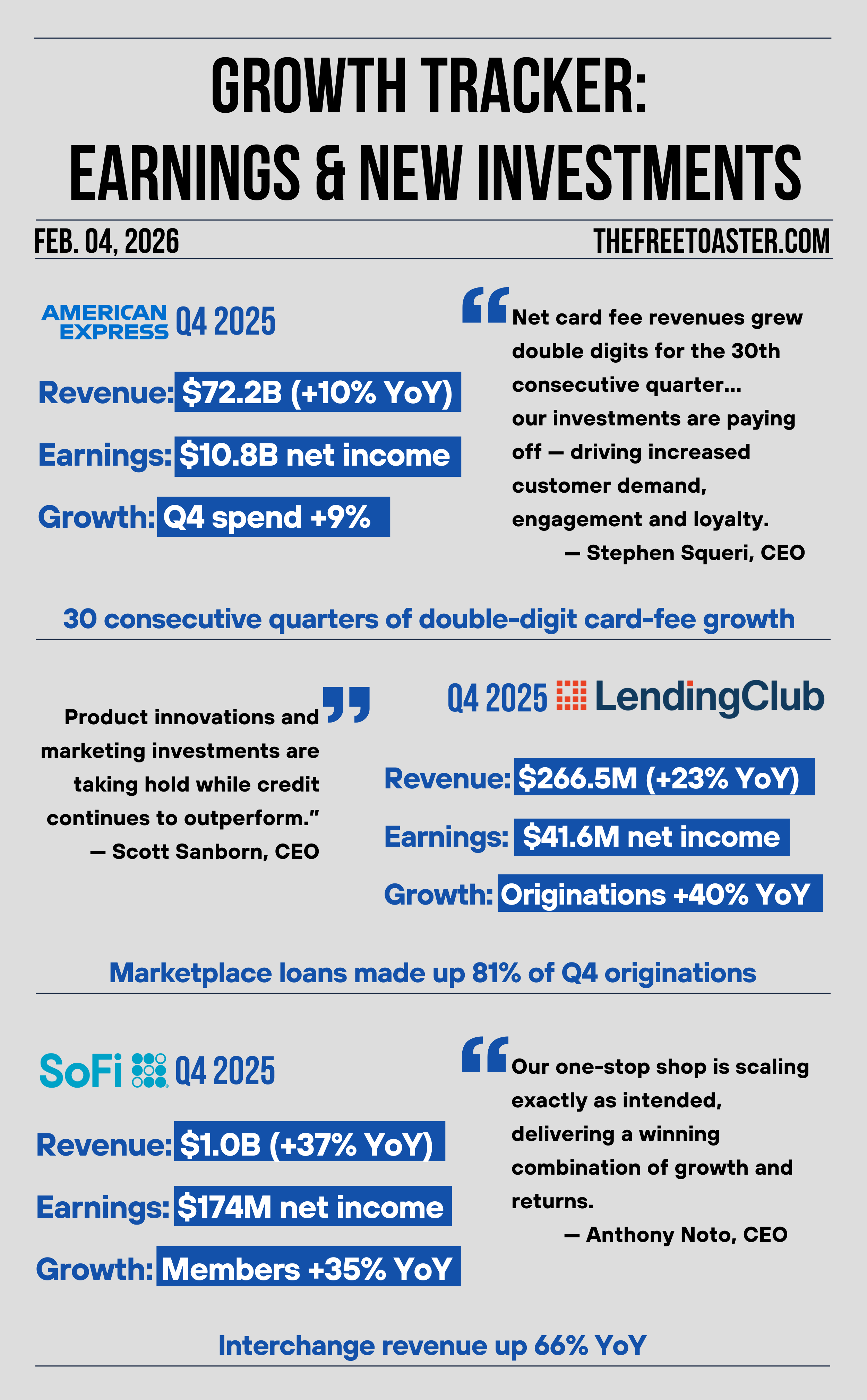
Sources: American Express, LendingClub, SoFi
Looking for a new role?
The Free Toaster Jobs Edition tracks where fintech teams are actually investing across marketing, product, data, credit, risk, and partnerships.


Other News We’re Reading
(Cards) Mastercard Launches Agent Suite to Ready Enterprises for a New Era (Mastercard)
(BNPL) Bolt Picks Affirm to Add BNPL Options at Checkout (PYMNTS)
(BNPL) Expedia Group and Affirm Deepen Partnership, With US Exclusivity and Plans For Further Expansion (Business Wire)
(Lending) NEXA Lending Launches Agenetic AI Tools for Loan Officers (HousingWire)
(Lending) Intelligent Lending Partners With Adclear On Ai Compliance (IBS Intelligence)
(Banking) Tech Mahindra and FICO Partner to Accelerate AI-Driven Decisioning and Core Banking Transformation (Tech Mahindra)
(Fintech) Fintech Company Alkami Taps Adviser Explores Sale (Bloomberg)
(Cards) Barclays AAdvantage Cards Are Moving To Citi: What Cardholders Should Know (CNBC)
(Auto Finance) Volvo Car Financial Services and Bank of America Extend Relationship Through 2030 (Bank of America)
(Fintech) Revolut Selects ElevenLabs Agents To Bolster Customer Support (ElevenLabs)
(Banking) Starling Bank Targets US Mid-Tier Lenders In Software Expansion Push (FSTech)
(Banking) Lithic Expands Partner Bank Network with Addition of Stearns Bank (Lithic)
(Payments) Elavon Introduces Payments App Integrated With Microsoft 365 Applications (PYMNTS)
(Payments) Mobile Wallet Usage Soars, Even as Apple Pay Leaves Spend on the Table (PYMNTS)
(Fraud) Equifax Launches Machine-Learning Product That Detects First-Party Fraud (PYMNTS)
(Payments) Nuvei and WEX Partner to Expand Virtual Card Payments for the Global Travel Industry (Nuvei)
(Fintech) Seen Finance™ Partners with Nova Credit to Expand Credit Access by Leveraging Cash Flow Data (Nova Credit)
Spot something worth sharing with your team? Drop this week’s edition in their inbox:
https://www.thefreetoaster.com/p/wtf-2026-since-when-is-debit-now
Catch you next week,
The Free Toaster Team
P.S.: If you’d like to sponsor or host an event in the consumer lending community in 2026, we’d like to hear from you. The Free Toaster will be organizing & hosting curated events this year, and we’d love to work with you as a sponsor.