

Hey Toaster Readers,
This week is sponsored by our friends at Spinwheel.
On November 4, Chime announced Q3 earnings. Revenue came in at $718 million, up 32% YoY, and above the $705 million the company guided to in September. Active Members reached 10.9 million, up 20%.
Below are a few key takeaways we think a marketer at a lender would care about.
This was Chime’s first earnings call since it agreed to buy Stride Bank, its partner bank of more than seven years.
We transcribed the earnings call ourselves, so quotes link to the transcript or the source document.
Let’s get toasting!
- Carlos Caro & Nick Madrid, Founders of The Free Toaster
PS: We’re actively planning the Customer Acquisition Summit for Lending (Affiliate Edition) event on April 7-8th in NYC, and tickets go on sale on Dec 4th!
If you’re interested in sponsoring that event, please reply to this email or write us at info@thefreetoaster.com.
Summarizing Chime’s Q3
From the Q3 earnings presentation (quarter ended September 30th, reported November 4th):
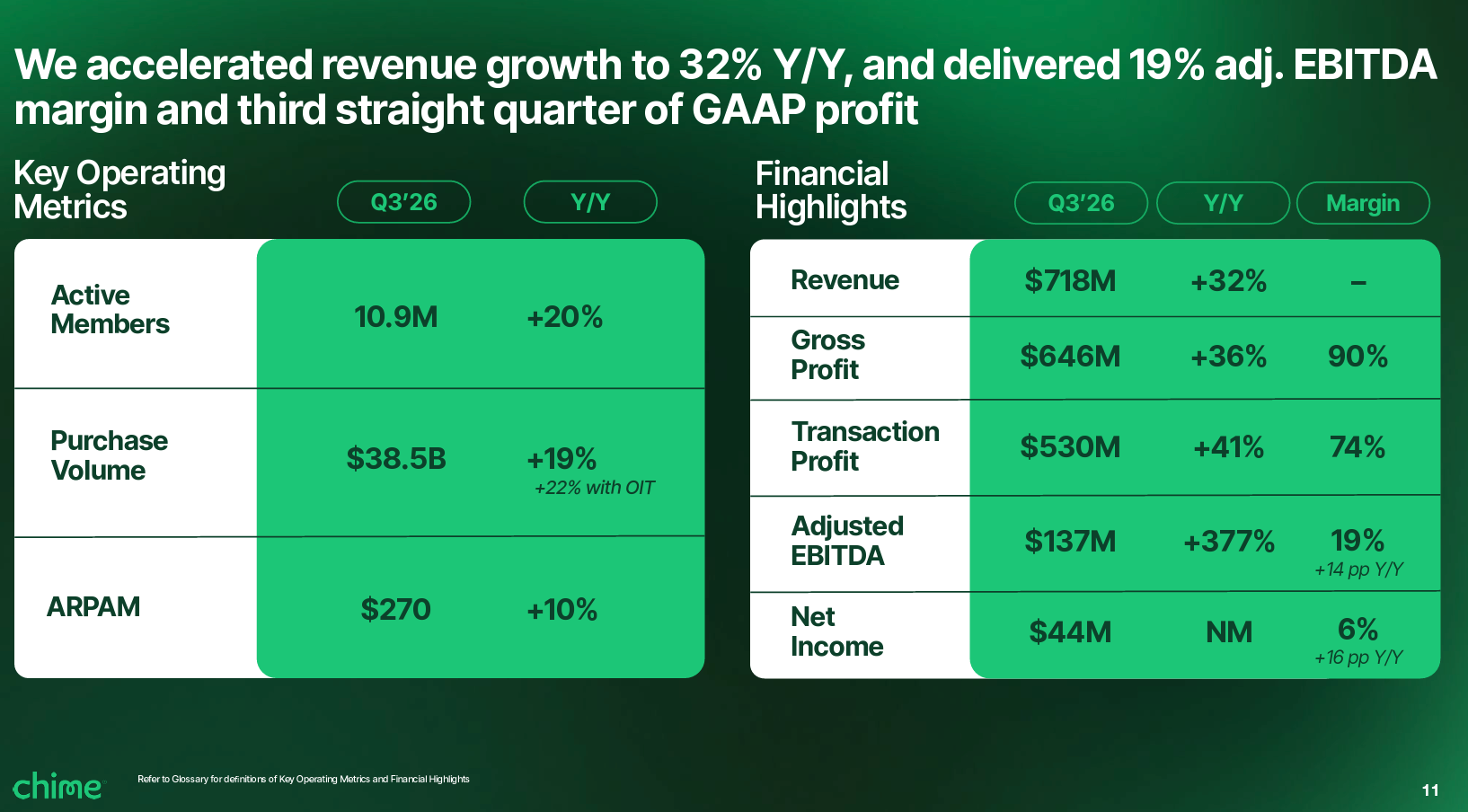
Q3 sales and marketing spend was $168.5M, up 9.7% YoY, while marketing spend as a % of revenue dropped
JPMorgan asked what’s working on member growth, and whether acquisition costs can fall further.
President and interim CFO Mark Troughton gave three reasons.
The first: “we’ve got better products now and we’re bundling them better.” He called the Chime Plus and Chime Prime bundles “more competitive” and “more compelling” (Q3 earnings call).
Chime Plus is the bundle for members with a qualifying direct deposit, and Chime Prime unlocks with $3,000+ per month in direct deposits.
His other two reasons:
“Number two, the brand continues to get stronger and stronger. And number three, I think we’re becoming better at optimizing the marketing channels, frankly. And I think those three are helping lead to the performance at the top of the funnel.” (Mark Troughton, Q3 earnings call)
Better at optimizing the marketing channels.
He didn’t say which ones.
The last breakdown we have is the S-1: since 2022, more than half of new members had come from organic and member-driven channels, and referrals were the single largest channel in 2024 (our S-1 breakdown).
Let’s level-set their marketing spend (from the press release and slides 32 and 36 of the Q3 presentation):
Sales and marketing: $168.5M in Q3, up from $164.2M in Q2 and $153.6M a year ago
As a share of revenue: 23% in Q3, 25% in Q2, 28% a year ago
Net new Active Members: about 500,000 in Q3; 1.8 million over the past 12 months, which Chime called a record
CAC (cost per new Active Member): $101, or $202 once you count the 50% Chime estimates go inactive in their first year
LTV to CAC: 9.9x on the $202 figure, up from “about 8x when we went public” (Mark Troughton, Q3 earnings call)
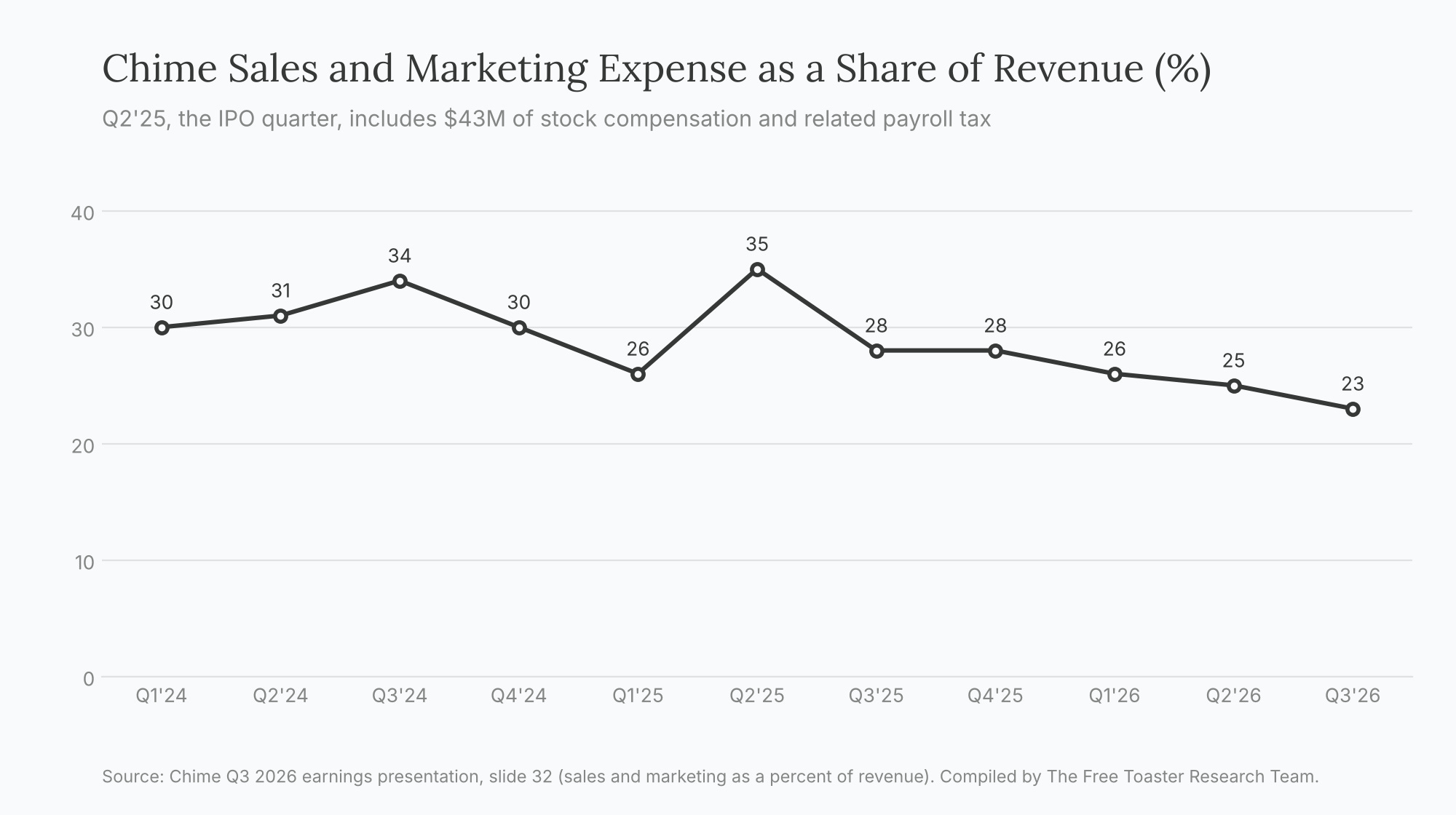
The dollars are still going up. The 10-Q cites “a $10.0 million increase in marketing and promotional activities” from a year ago, and Troughton told BMO “we’re not holding back” on marketing (Q3 earnings call).
Sponsored by Spinwheel
We couldn’t produce this newsletter without our sponsor (and friends) at Spinwheel, a QED-backed fintech.
Cut your lending application down to two required fields, phone number and birthdate, with real-time credit data and payment processing built in. Spinwheel clients see application rates jump 20 to 30%. Get started today.
“We’re expanding our addressable market to serve all Americans earning up to $200,000”
CEO Chris Britt, in the same answer to JPMorgan, on what Chime hoped Prime would do:
“It would attract a broader segment of consumers, including consumers making over $75,000 a year. That continues to be our fastest growing population group. And these folks are signing up for direct deposit at a faster clip, and a greater percentage of them are doing the $3,000 or more of deposit in order to qualify for Chime Prime and all the benefits that come with that.” (Chris Britt, Q3 earnings call)
At its IPO, Chime pitched Americans earning up to $100,000 a year. Now: “we’re expanding our addressable market to serve all Americans earning up to $200,000” (Q3 earnings call).
Two credit products are coming for that customer: a line of credit in beta, and an unsecured credit card due next year. Troughton told KBW they’ll “help us target these members in the $75K and in the $100K to $200K segment,” and that Chime “will start low and grow” (Q3 earnings call).
Chime says they have the most competitive paycheck advance product on the market (MyPay)
MyPay pays members before payday: free within 24 hours, or instantly for a fee (10-Q). Chime doubled the maximum to $1,000 in Q3.
Deutsche Bank pointed out that a lot of competitors are scaling similar products for similar consumers, and asked how Chime competes. Troughton named Dave and Cash App:
“So if you were to look at our yield relative to some of the other players in the market, I’m not going to single any one of them out, but whether it’s Dave or Cash App or anybody else, I think you will find that our average yield is much lower, in many cases, maybe even less than half. And that means that our pricing level is maybe even less than half what they’re charging. So, if anything, we see that over time, there may be opportunities to raise prices. That’s not our goal today.” (Mark Troughton, Q3 earnings call)
He also said “we really don’t see the short-term loan providers as our key competition.” The big banks are, since that’s where most of Chime’s new members come from.
MyPay by the numbers (slides 21 and 22 of the Q3 presentation):
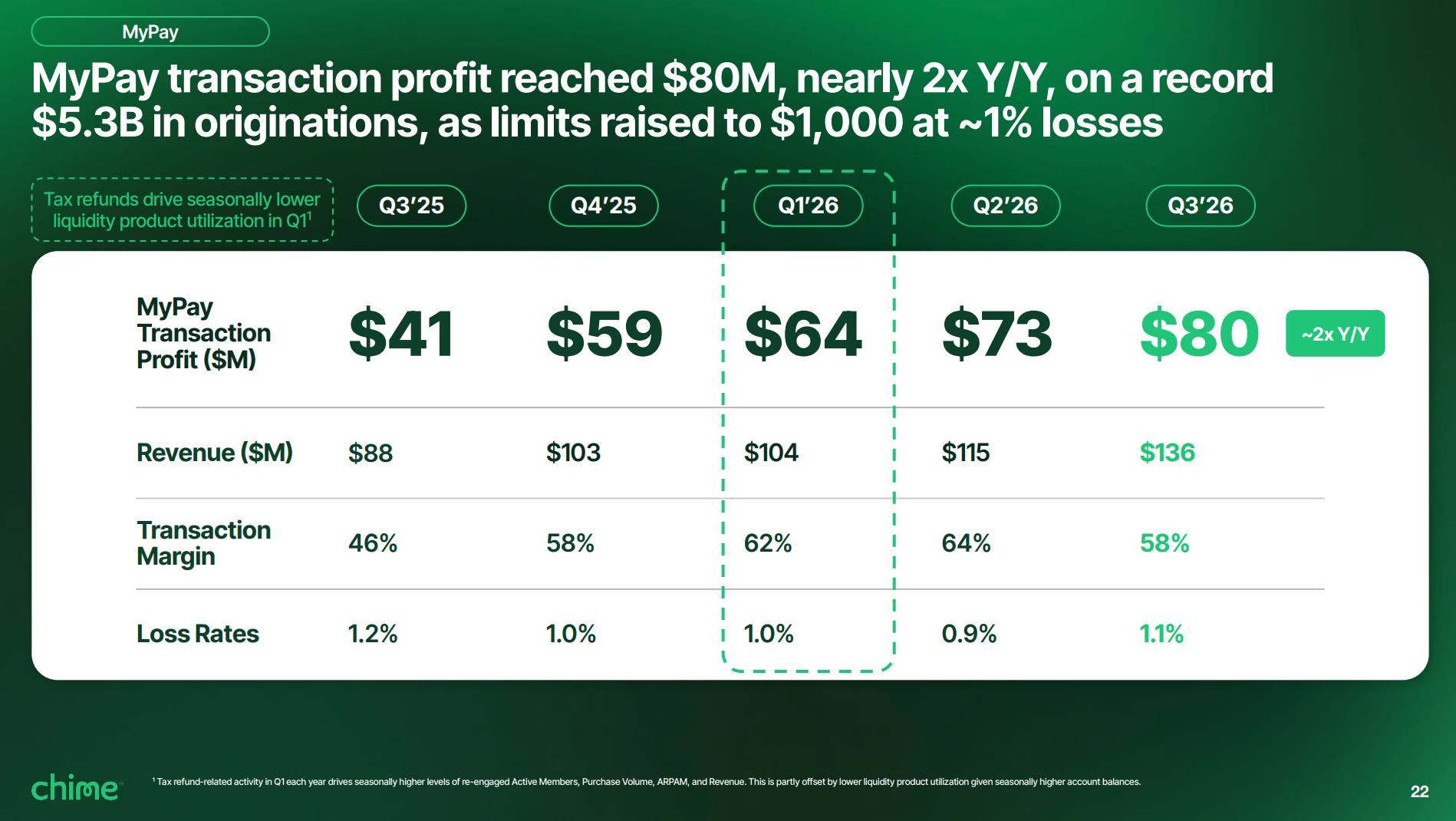
Revenue: $136M in Q3, $115M in Q2, $88M a year ago
Loss rate: 1.1% in Q3, 0.9% in Q2, 1.2% a year ago
Revenue left after losses: $80M in Q3, up from $41M a year ago
The average MyPay user advanced about $600 a month, up from $500 in Q2 (Mark Troughton, Q3 earnings call)
$136M of revenue on $5.3B advanced is about 2.6 cents per dollar.
MyPay is available to only 85% of Chime’s members, and owning Stride Bank would make it 100%
Goldman Sachs asked how much of the deal’s benefit comes from Chime’s existing business. Troughton listed faster product launches, cheaper funding and no more partner-bank fees, then lending:
“Today we operate to some extent on a state-by-state basis, and having a national charter would enable us to expand that. As an example, MyPay today is only available to 85% of our member base. And as a result of this acquisition, we would clearly be able to extend that to 100%.” (Mark Troughton, Q3 earnings call)
The deal, from the September announcement, Chime’s prepared remarks and the 10-Q:
Price: $590M in cash
Expected to close in the first half of 2027, pending regulatory approval
Expected benefit: more than $100M a year after tax, with the full amount 12 to 18 months after closing
Chime plans to move accounts from its other partner bank, The Bancorp Bank, onto Stride
Morgan Stanley, Chime’s adviser on the deal, wrote in September that “eliminating reliance on partner-bank timelines and risk tolerances can meaningfully improve execution and ability to develop credit offerings” (Morgan Stanley, “Accelerating the Story with Stride,” 2026-09-09).
Some quick hits before we wrap up
Chime thinks AI agents will pry customers away from big banks. Britt: “AI agents will make it easier for consumers to find better value financial products and make the switch, eroding the inertia that has protected big banks for decades.” Chime’s “biggest bet” is Jade, its personal finance agent, “already available to millions of members” (Q3 earnings call).
Enterprise, Chime’s employer channel, is a 2027 story. Chime signed and launched Michaels (nearly 40,000 U.S. employees), added the City of Charleston as its first public-sector employer and expanded its Workday partnership (press release). Evercore ISI asked whether it moved member growth this quarter. Troughton said it “is clearly making a contribution today,” but “it will be next year before it makes a truly meaningful contribution” (Q3 earnings call).
Instant Loans’ top end is $1,000 to $2,000, and Troughton says it could go higher. More than 20% of Active Members use the product (press release). Troughton to Wolfe Research: “At the high end, today we’re in the $1,000 to $2,000 range. Over time, there’s no reason why that couldn’t flex to three or five or ten in a moderate way for our highest income members” (Q3 earnings call). He means thousands. When we covered the launch in March 2025, the max was $500.
They raised Q4 guidance and expect to grow faster. Q4 revenue guidance is $757M to $767M, up 27% to 29% YoY (press release). Troughton: “We now expect to grow faster in the coming years than we previously anticipated” (Q3 earnings call).
Our congrats go out to Chime for a great quarter. We look forward to seeing how they progress on their initiatives from here.
Catch you next week,
Carlos Caro & Nick Madrid
Founders of The Free Toaster
If you noticed something we missed, please reply to this email and let us know.
P.S.: If you’d like to sponsor the Customer Acquisition Summit for Lending in NYC please reply to this email or write us at info@thefreetoaster.com.
For a comp, SoFi spent $444M on sales and marketing in Q3, about 32% of revenue vs Chime's 23%, and added roughly 1.26M members against Chime's ~500K. Member definitions differ, but SoFi is clearly still paying up for growth