


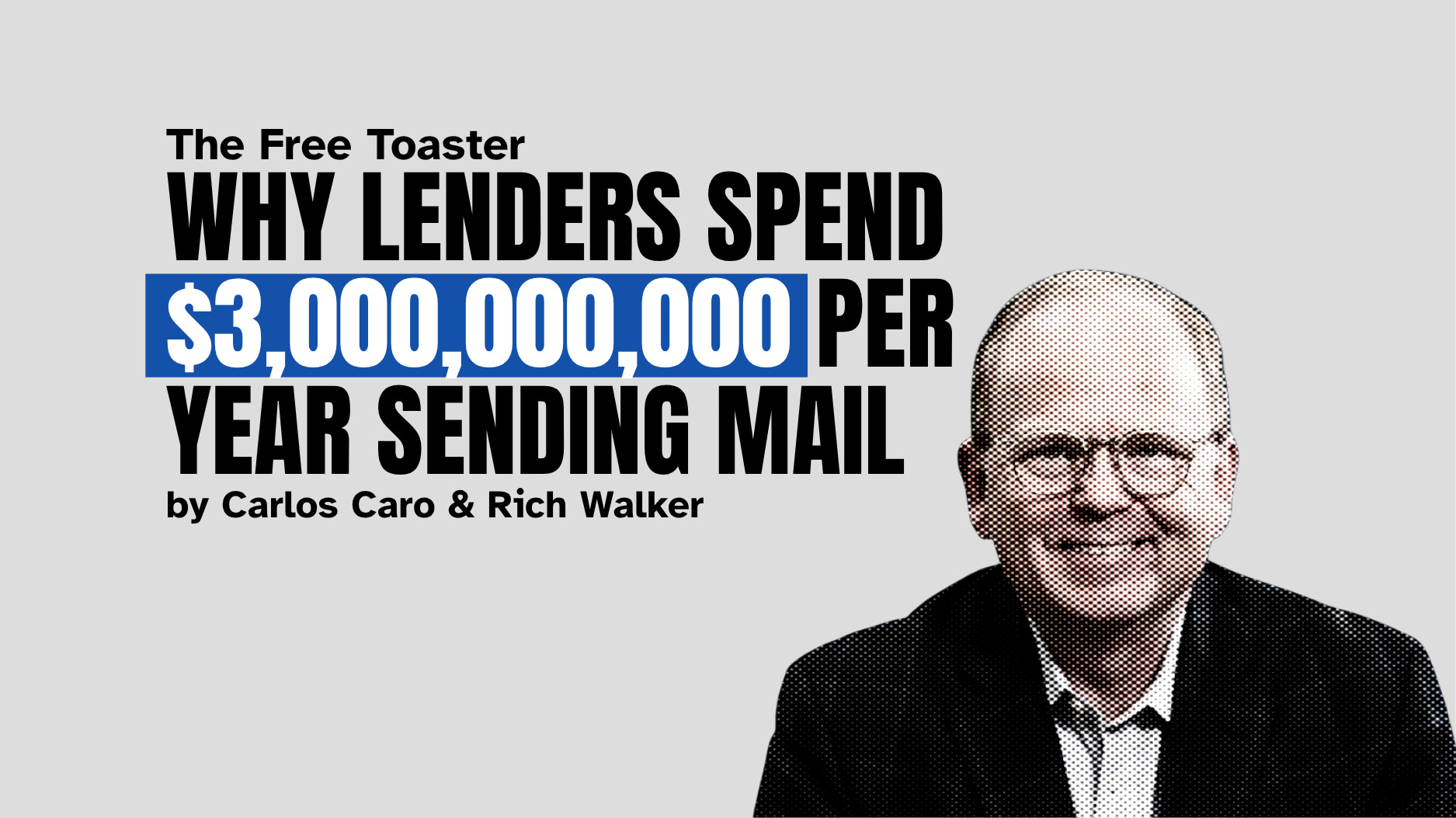
Rich Walker is a 35-year industry vet who’s been responsible for over 10 billion pieces of Direct Mail.
Rich has led direct marketing teams at Capital One, the Winterberry Group, Deluxe Corporation, and 2nd Order Solutions. Currently, he works on growth at Aven.
So we jumped at the opportunity to get his take on how lenders can leverage Direct Mail to grow their customer acquisition programs.
Find the show here:
Spotify // Apple // Audible // Podbean // iHeart
1/ Why Direct Mail still matters
Consumer lenders spend $3B per year on 6B mail pieces, and the power of pre-screened marketing. Thanks to the Fair Credit Reporting Act (FCRA), you can “pull” certain consumers’ credit data at the marketing stage (without permission) and decide exactly who qualifies before you send the offer.
You’re hitting people who are not actively shopping, but who are already qualified for a loan. That’s key. It’s the opposite of affiliate. In affiliate, they’re in-market and raising their hand. With mail, you can find them first.
Rich Walker
2/ Who should explore Direct Mail
Rich sees two broad categories of lenders that should be investing in direct mail:
Lenders with low LTV, but high response (low dollar subprime)
Lender with high LTC, but low response (high end prime cards, mortgages, etc)
If you’re new to lending altogether, direct mail might be a challenging first step. The best scenario is a lender who already has an underwriting model—something that sets FICO or risk thresholds, clarifies who is profitable to serve, and codifies that knowledge into a function or an algorithm.
You’d be surprised how many times I meet a fintech that wants to do direct mail but doesn’t really have a risk model. You need one. Mail is so expensive, you have to cut precisely—only the pockets that make you money.
Rich Walker
3/ Direct Mail vs. affiliate marketing
Affiliate marketing captures consumers who are already in-market. They go to aggregator or comparison sites, raise their hand, and say, “I want a loan.” That allows lenders to pay on a cost-per-acquisition (CPA) basis, without knowing who might respond.
But the trade-off is control.
In direct mail, you decide exactly who gets your offer—and you can hit them before they start shopping on aggregator sites. But, if your response model isn’t calibrated, your CACs could go much higher than expected.
4/ Unit economics
A piece of consumer-lending direct mail (one envelope, one letter) costs about 50 cents end-to-end:
Postage (~60%): Typically in the low 30-cent range, depending on volume and where it’s injected into the USPS system. There’s no vendor markup on postage—just a pass-through from the printer to the Postal Service.
Data (~20%): You purchase the list from a credit bureau (or a reseller). Pricing varies based on volume, the specific data you request, and the bureau’s own fee structure.
Printing/Inserting (~20%): Your “letter shop” or “mail house” charges you for the paper, ink, equipment run time, and finishing.
Naturally, if you’re testing small volumes early on—say 50,000 pieces vs. a million—you might see costs creep from 50 cents closer to 70–75 cents. But once you surpass a quarter-million pieces per run, unit costs begin leveling out.
5/ The mechanics of a campaign
A typical GTM motion:
Assemble Targeting Criteria: You define broad credit criteria (states, FICO range, existing tradelines, etc.).
Pull Bureau List: The bureau or reseller sends you the list of names that pass your risk and response criteria.
Develop Creative: Envelope design, letter copy, brand touches, invitation codes, vanity URLs, or QR codes.
Letter Shop Fulfillment: The printer physically prints letters and envelopes, personalizes them with your list’s PII (name, address, invitation code), then sorts them in ZIP order or deeper.
USPS Delivery: Typically 1–2 weeks from final print to the consumer’s mailbox, plus an additional 1–2 weeks of response tail to see final performance.
All told, one “test and learn” cycle can span 6–8 weeks. Compare that to the near-instant feedback loops of digital marketing, and you’ll see why mail requires a different cultural mindset.
6/ In-source or outsource?
In-House: Large lenders often keep the analytics, risk modeling, and segmentations in house. They may have direct relationships with bureaus and letter shops, and dedicated staff who handle each monthly “drop.”
Full-Service Outsource: For smaller or newer lenders, it may be easier to rely on specialized consultants who already have established bureau relationships, letter shop partners, and prebuilt campaign management tools.
Mail runs in cycles. You’ll have a super-busy ‘hell week’ where you finalize your drop. Then you’ll have downtime while results roll in. For a lot of organizations, that’s easier to outsource.
Rich Walker
7/ Optimizing the 3 big levers
The mailing list, the offer, and the creative. Rich discusses the big questions you need to think about to nail all 3.
Mail is the ultimate test of your underwriting. You can push as hard or as soft as you want on your credit model. Want more volume at higher CAC? Loosen your thresholds. Need to tighten up? Move the cutoff the other way.
Rich Walker
Additionally, we cover attribution, the future of direct mail, and much more.
Find the show here:
Spotify // Apple // Audible // Podbean // iHeart
About Us
Welcome to The Free Toaster! The newsletter for marketing pros at fintechs, banks, and lenders.
Inspired by the free toasters banks used to give to each new customer, we’re here to help you acquire more customers at scale. We deliver fresh news, data, and insights to help you acquire more customers—minus the breadcrumbs.
Want to follow the authors on social media? Find Nick Madrid and Carlos Caro on LinkedIn.
Support us by sharing our content with your colleagues or on social media.