


For more than a decade, the digital economy operated on a beautifully simple premise: rank high on Google, get customers, and (hopefully) print money. Companies dumped billions into SEO like it was a reliable annuity.
Well, that annuity is past due and the foreclosure notice just arrived. It’s written in AI.
The most recent example?
In NerdWallet’s Q2 2025 earnings report, they shared that their credit card business is down 25% year over year, while the card category at large and competitors like Credit Karma have been growing.
Their explanation? "…more pronounced organic traffic challenges."
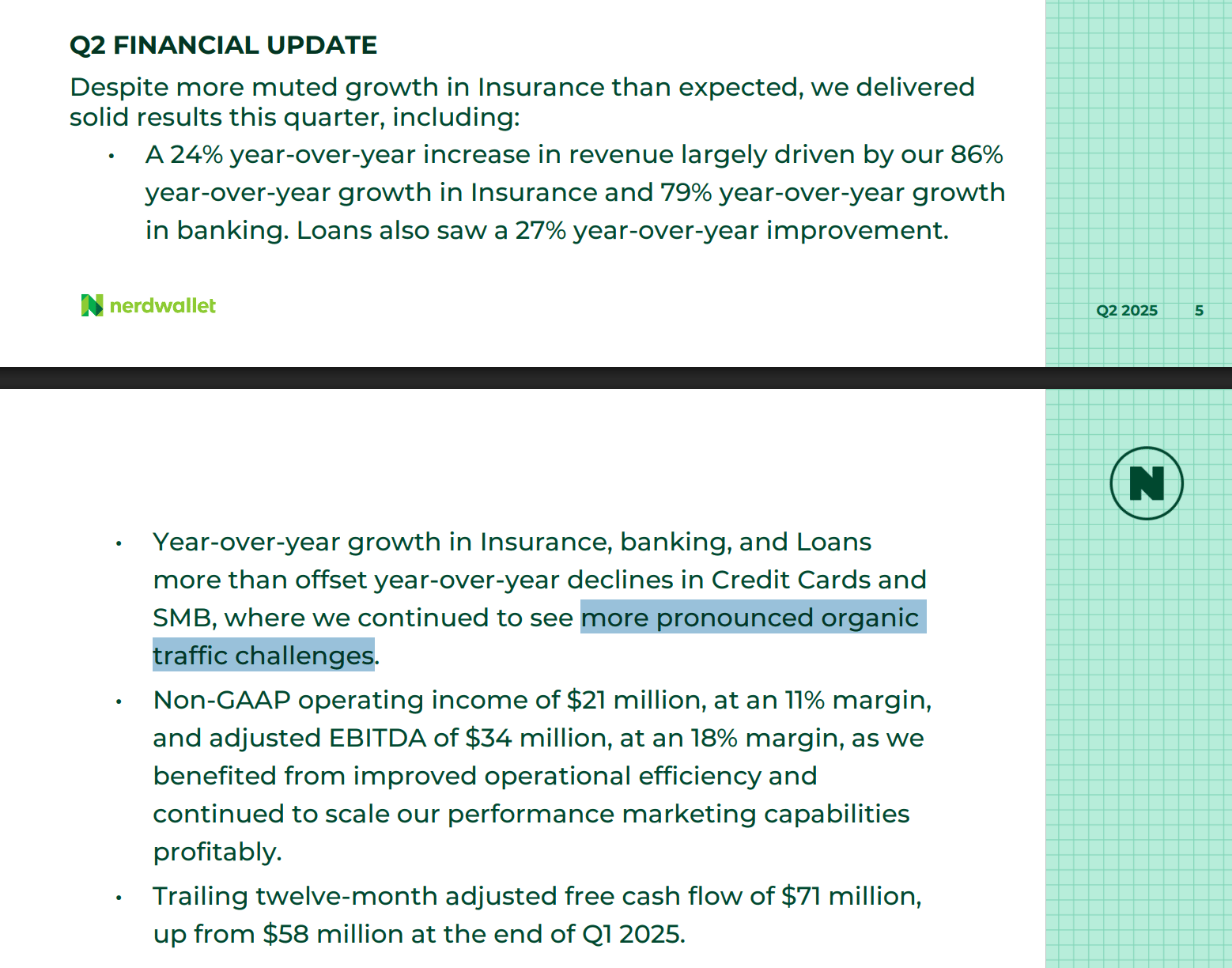
Source: NerdWallet’s Q2 2025 Shareholder Letter (highlighted text is the author’s emphasis)
The carnage is everywhere.
What many are calling an "extinction-level event" for content-driven businesses is a reality seen in traffic dashboards and earnings reports across Wall Street.1
This doesn’t feel like another algo update that will blow over. This is structural.
Google is systematically burning down (and rebuilding) the ecosystem that made digital content marketing initially viable, and they're doing it on two fronts.
The "Helpful Content" Ground-Clearing
Starting in September 2023, Google launched its "Helpful Content Update" (HCU)—a series of algorithm changes supposedly designed to reward content that's "helpful, satisfying and original".2 The stated goal was to reduce low-quality content visibility by up to 45%.2
Sounds reasonable, right? Except this wasn't just a spring cleaning. It was a strategic ground-clearing operation. The HCU introduced a brutal, site-wide penalty that could suppress a domain's entire visibility if Google deemed it had too much "unhelpful" content.3 This was Google curating the web for its true new customer: its own AI.
The move devastated independent publishers, with some losing up to 95% of their traffic.2 SEO strategist Lily Ray put it bluntly: "Google's just committing war on publisher websites. It's almost as if Google designed an algorithm update to specifically go after small bloggers".2
The subsequent June 2025 Core Update only accelerated the chaos, introducing "widespread volatility" and further cementing the shift toward an AI-first world.7
The Birth of Zero-Click
With the web prepped for machine consumption, Google unleashed its endgame: AI Overviews.
These AI-generated summaries now appear at the top of search results, answering user questions directly on the page.1 Why send users to your website when Google can just scrape your content, synthesize it, and present it as its own?
This is the "Great Decoupling"—the severing of the economic link between creating content and getting traffic.23
Let’s check out the stats:
Zero-click searches for news queries have surged from 56% to nearly 69% since AI Overviews launched.24
A Pew Research Center study found that when an AI summary appears, users are half as likely to click a traditional link, with the click rate collapsing from 15% to just 8%.1
One lifestyle publisher watched their click-through rate for a page-one ranking collapse from 5.1% to 0.6% in a year.26
An automotive publisher saw a 25% traffic drop despite ranking first in organic search.26
It’s almost like Google is saying: "Thanks for creating all this content we can train our AI on. OK thanks, bye."
The Damage Report: Nobody's Safe
The SEO changes are hitting everyone from small blogs to publicly traded companies.
For smaller publishers, it has been an extinction event.
The popular travel blog The Planet D was forced to shut down entirely after its traffic dropped by 90%.1
UK entertainment site Ready Steady Cut lost 50% of its traffic overnight and had to lay off its entire writing team.2
Even the giants are bleeding.
CNN's website traffic has dropped by approximately 30% year-over-year.1
OprahDaily.com lost 58% of its search traffic.2
New York Magazine dropped 32%.2
GQ.com fell 26%.2
It’s showing up in the Q2 2025 earnings reports, too:
NerdWallet (NASDAQ: NRDS)—a company that literally built a financial empire on search traffic—reported a brutal 25% year-over-year revenue decline in its Credit Cards vertical. Management didn't mince words, blaming “…more pronounced organic traffic challenges”. When an SEO-driven business tells Wall Street that SEO isn’t working anymore, you pay attention.
HubSpot (NYSE: HUBS)—the company that wrote the playbook on content marketing—is now executing a massive strategic pivot. On their Q2 earnings call, the CEO revealed that a staggering 90% of the company's leads now originate from non-blog sources like social media and podcasts.29
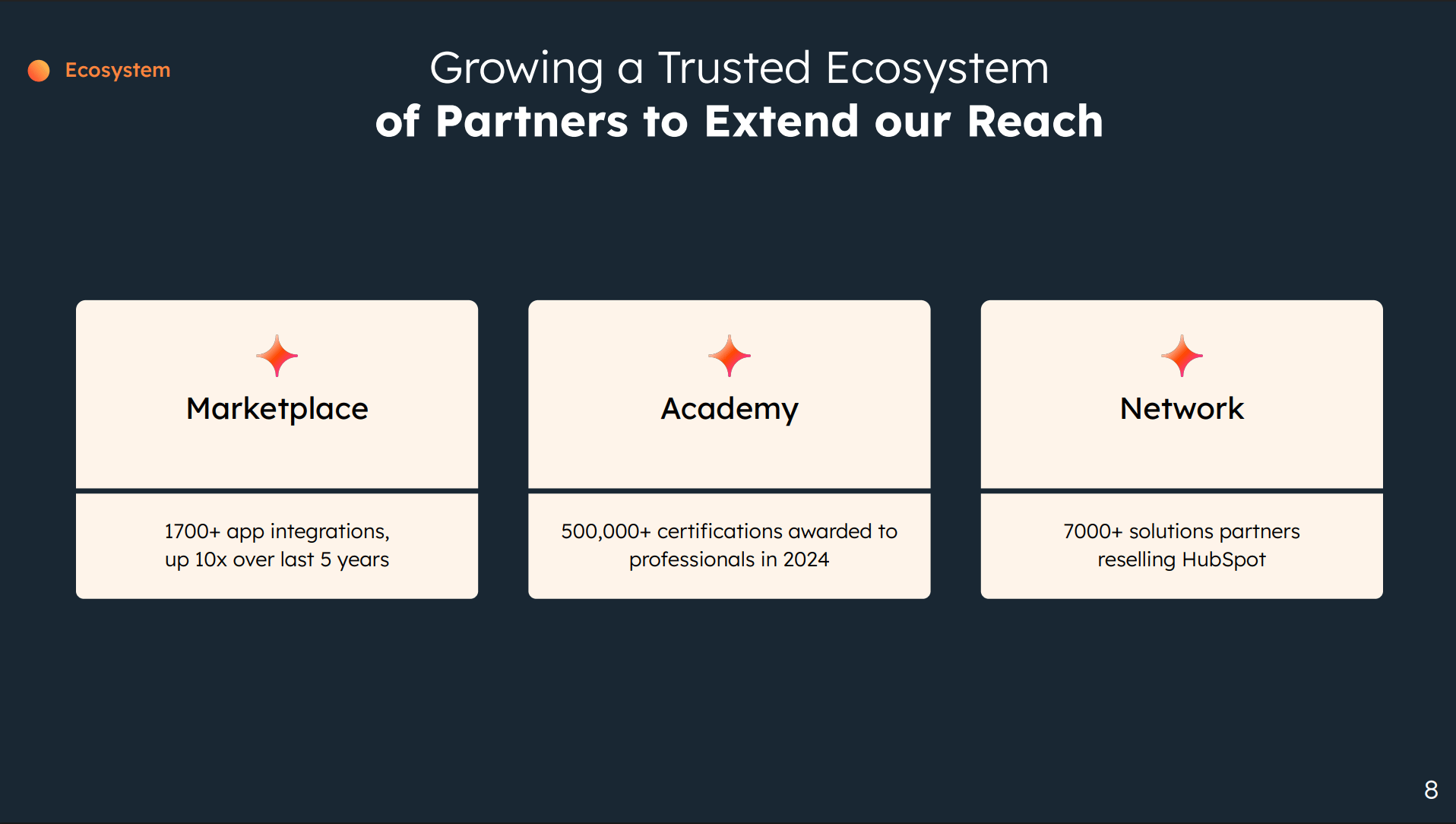
Source: Hubspot Q2 2025 Investor Presentation
That last point is worth repeating.
The company that taught everyone else how to do content marketing is actively de-risking its business away from the very search engine it helped everyone optimize for.
If HubSpot can't rely on SEO anymore, should you?
Where We Go From Here
Chasing Google's algorithm is like trying to solve a Rubik's cube that changes colors every time you touch it. The companies that survive this transition will be the ones that stop treating Google like a landlord and start building their own (media) real estate.
Action Item #1: Shift from SEO to GEO
Search isn't disappearing, but the optimization game has changed. The new discipline is Generative Engine Optimization (GEO)—making your content discoverable and valuable to AI models.30 The goal is no longer to rank #1 in a list of links; it's to become the trusted source cited within the AI's answer.
This means:
Directly answering questions with structured data (think Q&As, bullet points, and schema markup) so AI crawlers can parse your stuff easily.36
Doubling down on E-E-A-T (Experience, Expertise, Authoritativeness, Trust). In an AI world, verifiable authority is the ultimate currency.6
Building brand authority as a trust signal. When AI can't tell what's real, it will default to brands it trusts.38
Action Item #2: Build Natively, Everywhere
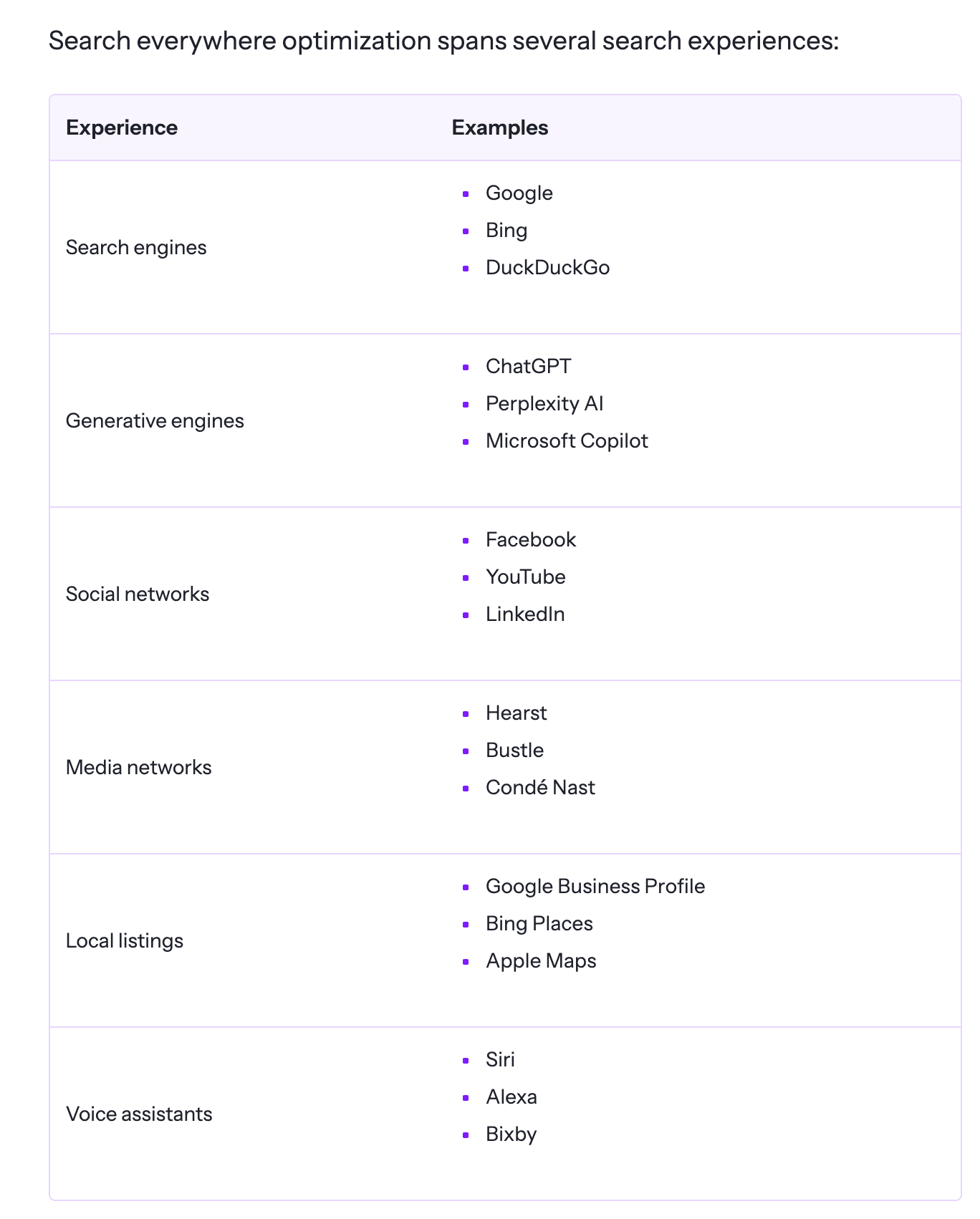
Google isn't the only game in town anymore. People search on YouTube, Reddit, TikTok, and Instagram26 . A shocking 40% of Gen Z now prefers searching on TikTok or Instagram over Google42 . The smartest companies are optimizing for "Search Everywhere" instead of putting all their eggs in one increasingly fragile basket.43
This requires platform-native content strategies:
YouTube for personality-driven education and tutorials.40
Reddit for authentic community discussions and earning trust.45
TikTok and Instagram for visual discovery and reaching younger audiences.42
Different platforms, different strategies. But all aimed at the same goal: reaching your audience where they actually are, not where Google used to send them.
Action Item #3: Build On Your Own Land
The ultimate defense against algorithmic chaos is a direct relationship with your audience. The future belongs to companies that own their customer connections, building assets that Google can't devalue overnight.
Email lists that can't be algorithm-nuked.
User accounts that create switching costs.
Mobile apps that bypass search entirely.
First-party data that allows you to build resilient, personalized experiences without relying on a middleman.46
The Bottom Line
SEO is changing quickly. The age of algorithmic dependence is ending. And that might be a good thing.
This painful moment is forcing companies to do what they should have been doing all along: building their brands, creating genuine value, and forging direct relationships with their customers.
The brands that survive this upheaval will be more resilient, more defensible, and less vulnerable to the whims of a single platform.
Support The Free Toaster
Need an affiliate marketing platform/network? Chat with Fintel Connect
Need help hiring key roles? Email Connie Buehler and mention TOASTER
Need to improve application page conversions? Chat with Spinwheel
Need to accelerate your affiliate marketing? Chat with New Market Growth
Need to win on other growth channels? Chat with FIAT Growth
None of the above? Share our Newsletter in your favorite Slack channel

About Us
Welcome to The Free Toaster! The newsletter for marketing pros at fintechs, banks, and lenders.
Inspired by the free toasters banks used to give to each new customer, we’re here to help you acquire more customers at scale. We deliver fresh news, data, and insights to help you acquire more customers, minus the breadcrumbs.
Want to follow the authors on social media?
Carlos Caro is the founder of NMG, an agency that helps lenders build affiliate programs.
Nick Madrid is the co-founder of Ghostmode, a media company that builds Newsletters, Podcasts, and communities in high-value B2B niches.