


I’ve spent the last six months chewing on a hiring problem that I’ve watched companies get wrong again and again: how to hire a VP of Partnerships.
After a decade in consumer lending partnerships—first scaling the partnerships team at Credit Karma from 3 to 25 people, then running acquisitions at Caribou, and now advising clients across millions in monthly affiliate spend at New Market Growth—I’ve developed a framework that I wish someone had handed me years ago.
But before we get to the seven traits, we need to dismantle a fundamental misconception.
The Big Lie About This Role
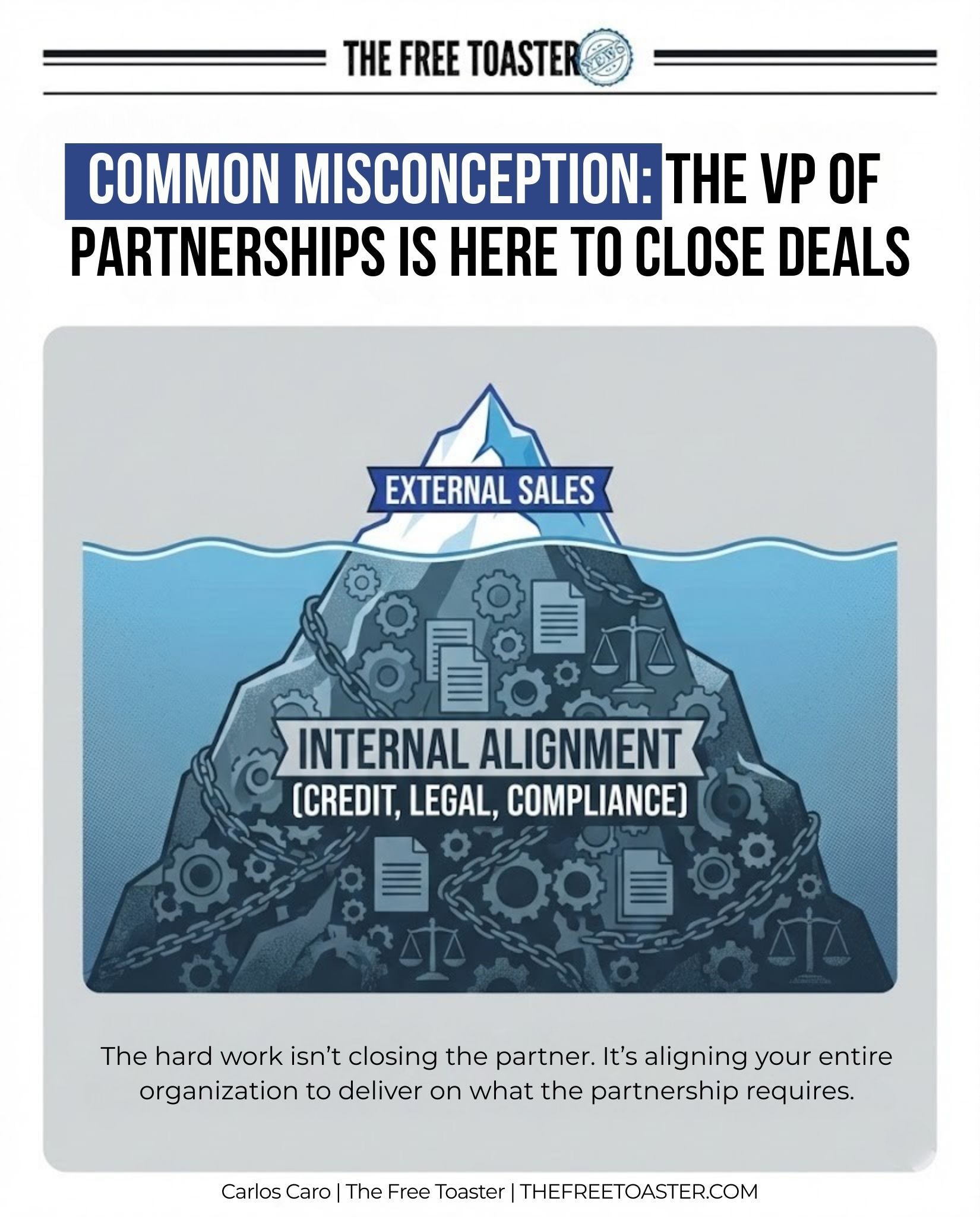
The VP of Partnerships job description reads like an external sales role. Go call on publishers. Negotiate deals. Turn on relationships. Shake hands. Move on.
That’s maybe 10-20% of the job.
Here’s the uncomfortable truth: the best VPs of Partnerships spend most of their time internally—talking to credit, product, engineering, legal, compliance, analytics. The hard work isn’t closing the partner. It’s aligning your entire organization to deliver on what the partnership requires.
Think about it. When a partnership goes live, it touches the product. It touches the marketing funnel. It touches credit policy. It touches compliance. It touches analytics and reporting. One person sits at the center of all of that, owning the outcome but controlling none of the levers.
This is the paradox of the role: you control nothing, but you influence everything.
A performance marketer running the Facebook or Google channel can buy media, control the message, control the audience, control frequency. A VP of Partnerships can do none of that. You can’t control what your external partners do. You can influence them, but you can’t control them. And internally? Every team you depend on has their own priorities, their own constraints, their own definition of what matters.
So if I had to distill this role down to one capability, it would be this: the ability to influence without authority.
That’s the single question you’re trying to answer in every interview. Can this person influence across multiple vectors—externally with partners, internally across every function they’ll touch?
With that frame in mind, here are the seven traits that separate great VP of Partnerships hires from expensive mistakes.
Trait 1: Deep Empathy for the Publishing Side
This one is most obvious when it’s missing. You’ll see a candidate who talks about “strong-arming” results, who leads with “do this or else,” or who expects compliance simply because they’re the client spending money.
That approach might work in some business relationships. In affiliate partnerships, it won’t get you anywhere.
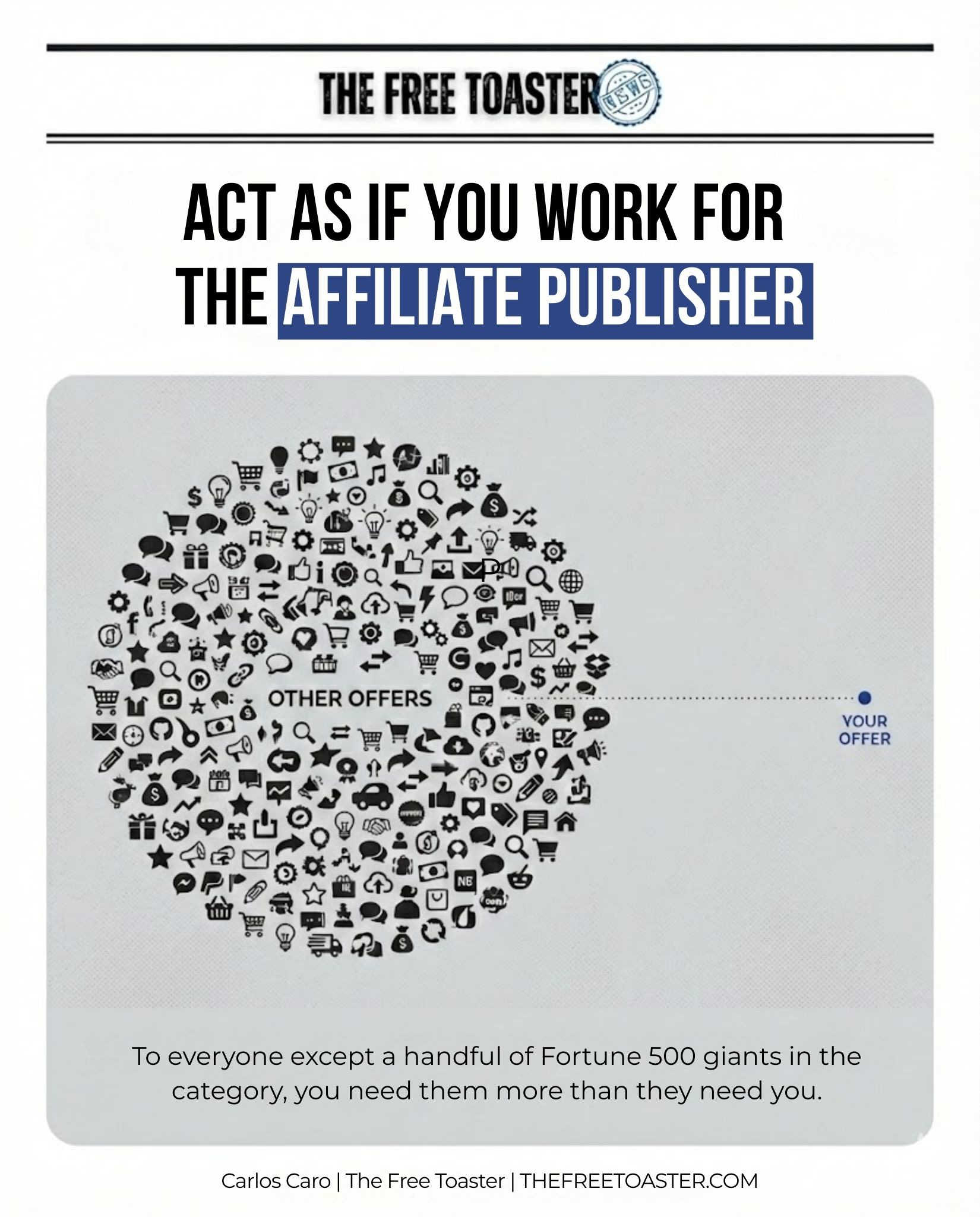
The reality: publishers run dozens of offers—sometimes 50 to 100. You’re coming in to be offer number 101. To everyone except the handful of Fortune 500 giants in the category, you need them more than they need you.
The mindset shift I encourage is simple but profound: behave as if you work for the affiliate publisher.
This isn’t servility. It’s strategic clarity. You earn your seat at the table by bringing great customer value, a marketing funnel that converts, offers that monetize well for the publisher or serve an incremental audience they can’t reach otherwise. Everything you do needs to be a win for them first.
The interview question: Tell me about a time when an affiliate publisher wasn’t getting you what you needed. What was the situation and how did you handle it?
You’re not listening for the example itself. You’re listening for tone, word choice, how they frame the power dynamic. Do they come with a service mindset? Are they offering ideas that work for both sides, but selling them in the context of what makes it good for the publisher? That’s what you’re looking for.
Trait 2: A Positive-Sum Thinker
A candidate with this trait believes—genuinely—that both sides should come away better from every deal. It’s not one side extracting value from another.
The antithesis looks like this: a VP of Partnerships whose first strategic idea is to squeeze every affiliate publisher on payouts. “Let’s go negotiate down our CPAs.”
If that’s the agenda, you don’t have a positive-sum thinker. You have someone who’s going to make the publisher worse off to make the lender better off. The pie doesn’t grow. You’re just transferring value.
In consumer lending, there are actually three constituents to consider: the consumer, the affiliate publisher, and the lender. The best VPs of Partnerships apply all three lenses to every strategic initiative. Is it good for the lender’s economics? Is it good for the consumer (because the publisher will absolutely be evaluating this—that’s their customer)? Is it good for the publisher’s economics?
The interview question: Walk me through a deal or initiative you led that you were really proud of, and why.
Listen for whether the outcome was a clear win-win. Was there creativity in how it came together? Extra credit if they mention the third constituent—the consumer—without being prompted.
Trait 3: Deep Awareness of the Credit-Marketing Feedback Loop
This might be my favorite trait because it separates people who’ve done this job from people who’ve observed this job.
Here’s the concept: every marketing decision is a credit decision.
When you tweak an offer, change how you explain it, adjust pricing, modify how you communicate to consumers—you don’t just change the number of people who respond. You change the types of people who respond. The consumer selection shifts.
Now flip it. Credit tightens the buy-box. The VP of Partnerships didn’t make that decision, but they need to understand its ramifications. Fewer consumers will be eligible for the offer. That reduces the approval rate and may encourage the publisher to reduce impression volume or reduce offer ranking, because now the marketing funnel looks less efficient from their perspective. Credit decisions are marketing decisions, too.
You need a leader who spots these connection points instinctively. It helps them avoid strategic mistakes, and it helps them spot opportunities others miss.
The interview question: How do credit and underwriting decisions impact your work? Walk me through an example when marketing and credit worked in close alignment.
If they struggle, try the inverse: Walk me through an example where marketing and credit weren’t well aligned. If you could wave a magic wand, how should that interaction have gone?
You’re looking for someone who not only understands the feedback loop but has experience negotiating with credit teams to get good outcomes in the affiliate channel.
Trait 4: Able to Explain Complex Concepts Simply and Clearly
Under the umbrella of influencing without authority, this person needs to land complex topics with diverse audiences—quickly and clearly. When that doesn’t happen, they can’t influence because no one knows what they want (or why they want it)!
I’m thinking specifically about verbal communication here.
The interview question: Tell me about a time you had to communicate something complex to a CEO.
Some candidates assume the CEO needs every detail and nuance. It’s the opposite. The CEO needs what matters, the context, and a couple of headlines or stories that let them wrap their arms around the theme and understand why it matters to both the partner and the business.
Look for stories, metaphors, analogies. Did they eliminate the jargon? Every industry has its own shorthand, but in partnerships you can never assume the other side shares your vocabulary. Clear, concise, non-technical language—that’s the bar.
Trait 5: Telling Stories With Data (in PowerPoint)
This one seems almost too obvious to mention. But it’s on the list because I’ve made senior hires who weren’t great at this, and it turned into me into their personal deck writing assistant. (Never again. Never again).
In a role where you influence everything but control nothing, you cannot get away with messy decks. Other functions can survive this because they have direct levers—they can change things in the business that drive outcomes. This role doesn’t have that luxury. This role needs other people to do things. And that means convincing people, which means communication quality is mission critical.
Here’s the compounding problem: if you hire a VP of Partnerships who isn’t good at this, their team won’t be good at it either. They won’t know what to look for when hiring. They won’t be able to coach. You’ll end up with an entire function that’s ineffective at communicating in the medium that matters most.
There’s no interview question for this one. You have to test it directly.
Give them an Excel sheet with real (anonymized) data. Keep it manageable—10 to 20 observations, five to eight columns. Something you could stare at on one laptop screen. Ask them to study the data, identify trends, then prepare a short deck answering two or three business questions.
What you’re looking for:
A story, not a data dump. I’ve seen candidates take an eight-column dataset and show up with 32 charts—just re-visualizing the table with no narrative, no point of view.
Clear writing. Sharp. No jargon.
Charts that make a point. They’re extracting the insight, not just displaying the data.
Defensibility. Pressure test them. Make sure nothing is misleading. They should be able to defend what’s on the page.
A four-to-eight slide deck won’t produce a bulletproof argument, and that’s not the point. The point is clear storylines and thoughtful visualization in service of a point of view.
I typically use this in the late stage of the interview process—after they’ve met key stakeholders, when they’re a finalist. Give them a weekend, design it so it takes four hours or less, and watch what they produce. If you’d cringe forwarding these slides to an existing partner, you’re done. They’re not the right fit.
Trait 6: A Marathon Mentality
Can they lose for a long time without it impacting their confidence?
If you’ve been in this business long enough, you know: the hit rate can be brutal. You pitch lots of ideas to lots of people. The minority get accepted. And I mean hit rate all the way through—not just an initial head nod, but the initiative is accepted, fleshed out, delivered, and it worked.
That entire process? Sometimes you’re talking single-digit percentages.
But here’s what great VPs of Partnerships understand: one huge win is all it takes.
One key initiative, one new partnership can single-handedly change the trajectory of a business—especially at earlier stages. The power law applies. One winner can make a lot of other losses irrelevant.
You’re looking for someone who’s mentally tough, who doesn’t lose momentum when things don’t go their way, who stays positive and optimistic even through extended dry spells. You want evidence they’ve run marathons before—that they’re willing to endure pain for the right outcome without it wearing down their morale or how they treat others.
The interview question: Tell me about an extended period in your career where it seemed like nothing you were doing was working. How did you handle it? (Option 2: How would you coach someone on your team who wants immediate results after launching new partnerships?)
Listen for awareness that the hit rate can be very low, but one win can change everything. Listen for someone who enjoys the process—the game, the craft—even when outcomes aren’t cooperating.
Trait 7: An Artful Collector of Information
Here’s the final trait, and it’s subtle: can this person get someone else talking and talking and talking without ever asking a direct question or making them feel interrogated?
This matters because you need your VP of Partnerships to learn about partner needs, motivations, and constraints—from external publishers and internal stakeholders alike—without triggering defensiveness.
I’d point you to Chris Voss’s book Never Split the Difference for the tactical playbook here. The core tools are mirrors and labels.
Mirrors: playing back the last few words of what someone says with upward inflection, sounding curious. Partner: “I’m not happy with this contract.” VP of Partnerships: “Not happy with this contract?”
Labels: naming what you’re observing. Someone seems frustrated, so you say, “It sounds like you’re frustrated about XYZ thing” and let them correct you or agree and continue talking about that thing.
These techniques get people talking without you ever asking a question or making anyone feel defensive. I’ve been on the other side of the table with people who are masterful at this, and it’s remarkable how much I’ll share—information I wouldn’t have offered otherwise—because they’re so good at mirroring, labeling, and listening.
There’s no single interview question for this. What you do instead is give them space to learn about the role and company. Frame it up: “This is your time now. Is there anything you’d like to learn about the company, about me, about the role?”
The best candidates will already have demonstrated this trait throughout the interview—in how they’ve handled all your questions. But in this dedicated time, watch for:
Observations that land like questions: “Based on something you said earlier, it seems like you’re concerned about the long-term health of the LendingTree relationship...” (upward inflection at the end, inviting you to elaborate)
Evidence they were paying attention
A conversational, generative vibe
Red flags: Direct, pointed questions that make you feel defensive or uncomfortable. If they’re doing that to you in an interview, they’ll do it to a partner in a high-stakes situation—and turn what could have been an exploratory conversation into a tense interrogation.
If you ever feel interrogated, if you ever feel pushed to share more than you’re comfortable with, that’s a sign this person may not be right for the role.
On the other side of the coin, a candidate that doesn’t dig, dig, dig for more information isn’t going to work either. You need to feel like you shared alot without feeling like you were on the witness stand.
Wrap Up
The VP of Partnerships role is not what it looks like on paper.
It looks external, but it’s actually highly internal. It looks like sales, but it’s actually influence. It looks like closing deals, but it’s actually aligning organizations.
You want someone who can influence without authority—externally with publishers who have dozens of other options, and internally with teams who have their own priorities.
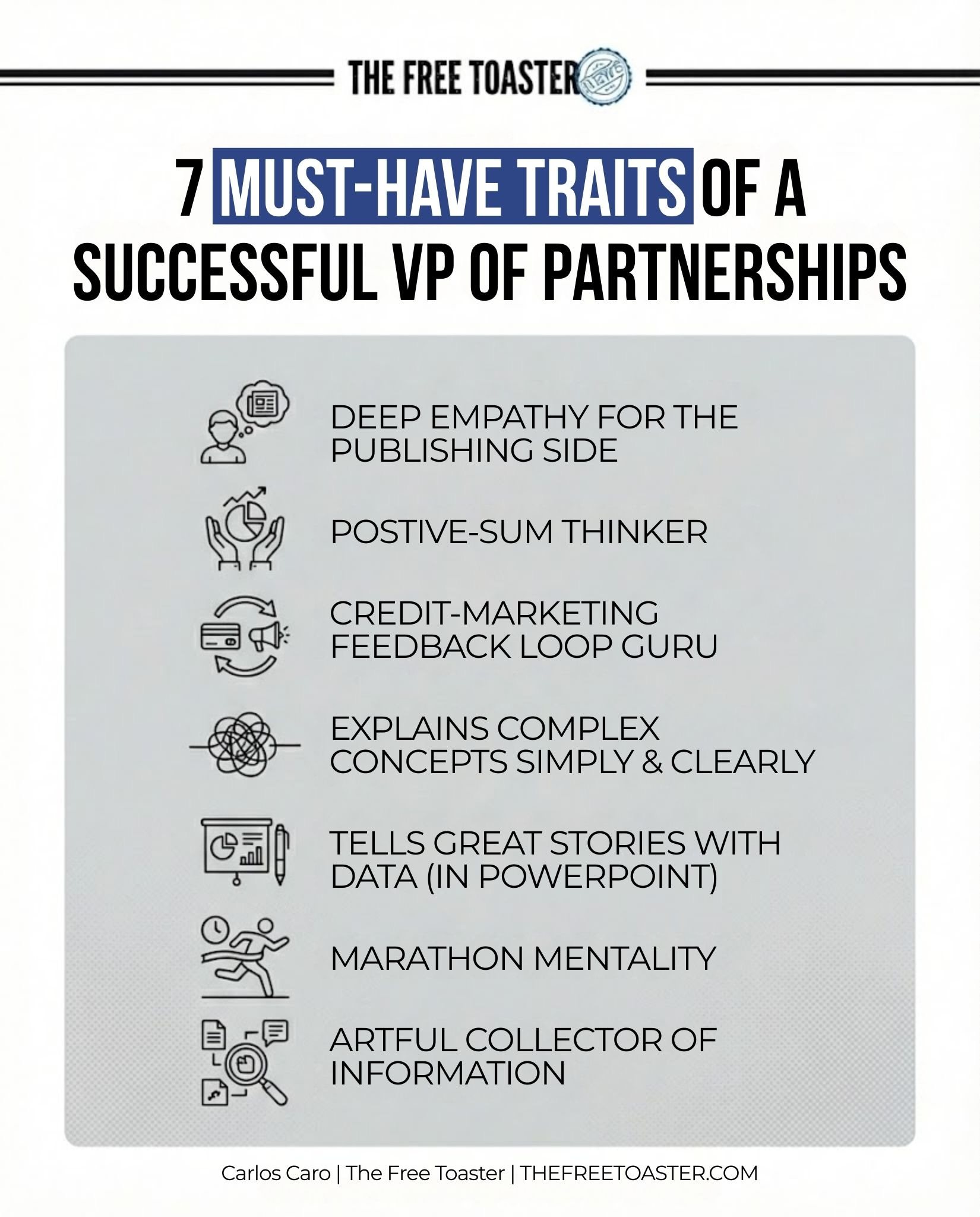
These seven traits give you a lens into how well a candidate can do that:
Deep empathy for the publishing side
Positive-sum thinker
Credit-marketing feedback loop guru
Explains complex concepts simply & clearly
Tells great stories with data (in Powerpoint)
Marathon mentality
Artful collector of information
Get this hire right, and you’ve got someone who can move mountains without owning any of the excavators.
Get it wrong, and you’ll spend the next year wondering why your partnerships aren’t scaling despite all the deals you’ve signed.
To support our Newsletter, please check out our sponsors:
Need an affiliate marketing platform/network? Chat with Fintel Connect
Need to improve application page conversions? Chat with Spinwheel
Need help with performance marketing? Chat with Bulldog Media Group