


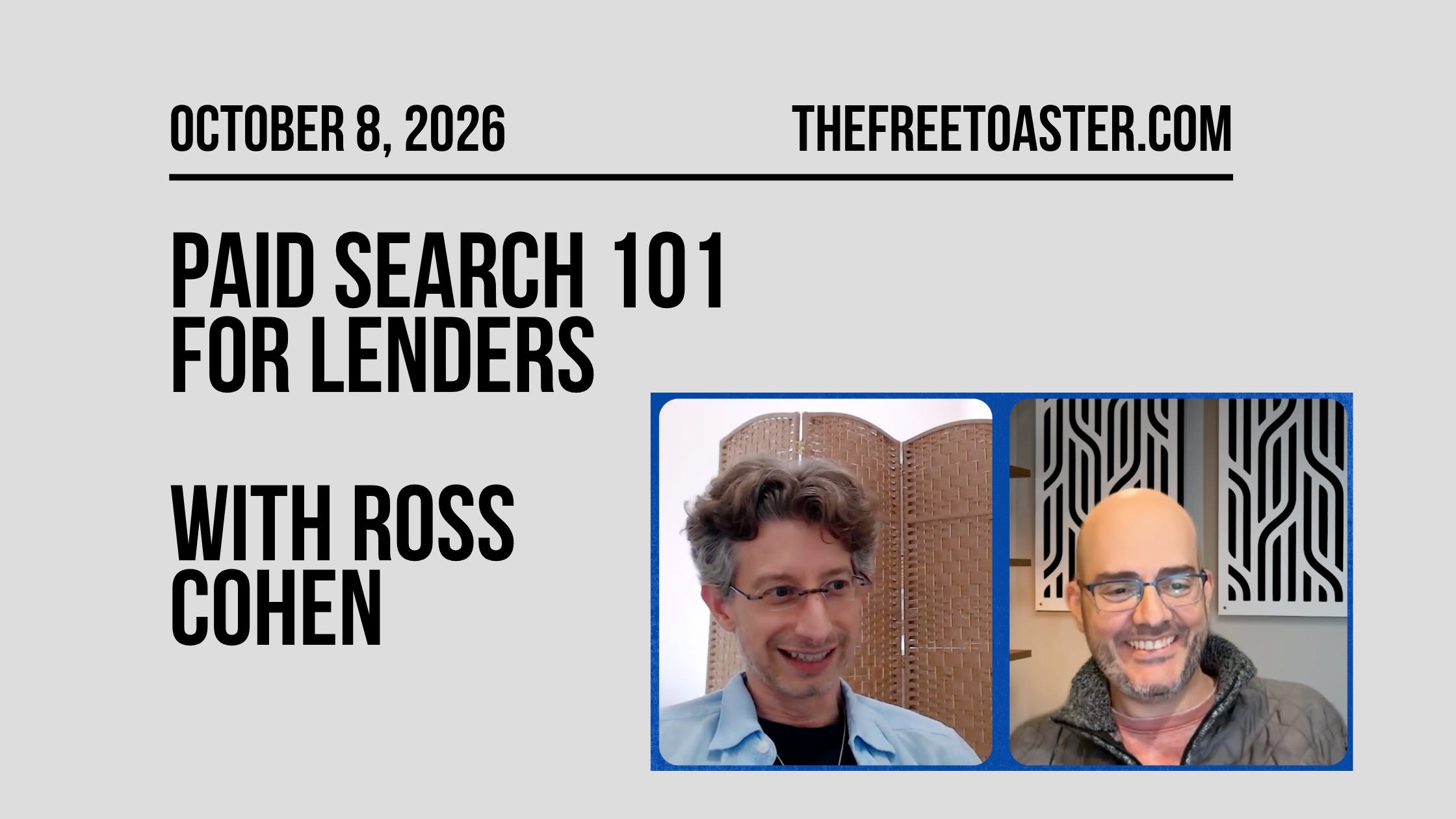
Ross Cohen has run paid search from a few different seats: COO at New York Life, media-buying client at FrontPoint, and hands-on operator at Greenlight (a legal services marketplace I co-founded with him in the COVID era).
And when I say hands-on, I mean it literally.
I’ve watched him inside Google AdWords building campaigns from scratch as the advertiser. He’s also sat on the agency side, managing search accounts for clients, which means he’s seen this from every angle.
Most of you know the rough math of a fintech lender’s marketing mix. It’s typically ~45% affiliates, ~45% direct mail, ~10% search and social. Search is a small line item that is both easy to deprioritize and easy to assume the agency has it handled.
But Ross makes a case that search punches above its weight class, and that the way many agencies manage it can be wasteful.
Listen to the full Free Toaster Podcast conversation with Ross here.
Why Search Punches Above Its Weight Class
First, it’s the best experimentation channel.
No waiting months for mail to hit
No waiting for an affiliate partner to change your placement (or agree to do the test at all)
Have an idea today, test it tomorrow, and get a signal quickly
As Ross puts it:
“I’d much rather know, I dropped this in market and I had 30 people actually apply for this product. It’s a very different level of insight. And with search, it’s directly in your control and it has very short cycle times.”
Second, it’s the shock absorber for your entire mix.
When DM volume drops or an affiliate partner pulls back, you can crank search in minutes. I put it this way on the pod: you can bid a $100 instead of $30 for clicks and your volume could be 10X in the same day. Your blended CACs will go up. But when you need to hit a number and another channel is underperforming, that optionality and speed can be worth a lot.
Affiliates and DM move slow and steady.
In paid search, you’re a keyboard stroke away from adding a “0” to your volumes.
Sponsored by Bulldog Media Group
Reach the Borrowers Others Miss
Bulldog Media Group specializes in connecting consumer lenders with less than perfect borrowers — a massive, underserved market that requires precision targeting to get right. With 25 years of financial services marketing experience, they deliver qualified leads through affiliate marketing, targeted email, and data-driven acquisition strategies built for this exact audience.
How Search Mirrors Affiliates (Ranking)
One thing should feel familiar if you live in affiliate marketplaces.
Google ranks you on bid multiplied by quality score, not just bid, so the highest CPC (cost per click) bidder doesn’t automatically win. This follows the same logic big affiliate publishers run when they optimize revenue-per-impression. Google doesn’t care that you’ll pay $100 a click if nobody wants to click on it.
The instincts you’ve developed optimizing rankings in an affiliate marketplace are 100% in play when it comes to paid search.
Another way to think about it — Google’s Quality Score must look a lot like a large affiliate’s ranking engine when you look under the hood.

Why Agencies Miss the Mark on Lending
Most search agencies charge a percentage of spend, and Ross is careful not to bash agencies for it.
“There’s a fundamental misalignment in incentives going on here because most agencies charge some portion of channel spend… Their incentive is for you to spend more money because the more money you spend, the more money they make.”
They have little incentive to manage your expenses frugally, and they’ll always have great new ideas on where you can spend more. The model itself creates this dynamic.
“I don’t call that out to knock them, that’s just the model.”
The second problem is specific to our niche.
“It’s very rare to find somebody in the agency world who really understands the lending business.”
How Lenders Can Find An Agency They Can Trust
Ross has a handful of questions and data points any non-technical CMO can look at to evaluate potential agency partners.
Commingling branded and unbranded keywords. A branded click might cost 80 cents while an unbranded one runs $30. Commingle them in one campaign and “the branded terms become a hidden subsidy” for unbranded spend that isn’t working.
“That’s the first place I check because if you find that, your whole account is messed up.”
Search terms reports. That’s what people actually typed rather than the keywords that you bid on. Broad match terms sitting on a thin negative list that hadn’t been touched in a while means you’re probably letting Google have way too much free rein. This could mean the difference between placing your ad under a search that says “[brand] credit card” and “[brand] credit card sucks”.
Ask about what performance metric they’re optimizing (and what data they use to get there). Ross says that if your agency is talking to you in terms of CPL (cost per lead ) and celebrating low CPLs, that’s a big red flag and something to run from. Failing to feed funded-loan data back to Google is “the single most common structural failure in this space,” and he isn’t sure he has ever seen an account set up correctly the first time. Your agency needs to be locked in on optimizing CPA (cost per account) — both conceptually and from a data perspective.
Ask what they changed in your account last month. No changes? Red flag. Thousands of changes? Those could be automated, and you should ask them to walk you through why they made each change.
Check Google’s auto-recommendations. Auto-apply should be off. Ross’s rule: “If you don’t know, say no.”
The budget test. Ask, “If you had 20% more budget, exactly where would it go and what would my marginal cost per funded loan be?” This tests whether the agency understands the difference between average and marginal economics, or whether the answer is a hand-wavy 'scale what's working.'
A note of caution: Finding a single missing negative keyword doesn’t mean your agency is ineffective. “If they understand the big things we covered and they’re willing to work with you and they’re responsive, that’s probably 80% of the battle right there.”
Where To Start If You’re New To The Channel
If all of this sounds overwhelming for a channel that’s less than 10% of your acquisition program, Ross has one suggestion.
“My advice would be eat the elephant one bite at a time.”
You don’t need to solve everything at once. Work through the questions one by one and build intuition over a few weeks or months.
“You just need to get good enough that you can tell the difference between somebody who knows what they’re doing and somebody who doesn’t. And the bar for that is not that high.”
The Podcast with Ross checked all my boxes for a great episode.
A practitioner with decades of experience, a bunch of real life examples, a set of clear, practical suggestions anyone can follow, and a conversational, relaxed style that makes listening fun.
You can catch the Podcast here.

See you next week,
The Free Toaster Team
Carlos Caro, Founder at NMG, Co-Founder of The Free Toaster
Nick Madrid, Co-Founder of The Free Toaster and Uncovered Media