

Hey Toaster Readers,
This week is sponsored by our friends at Fintel Connect.
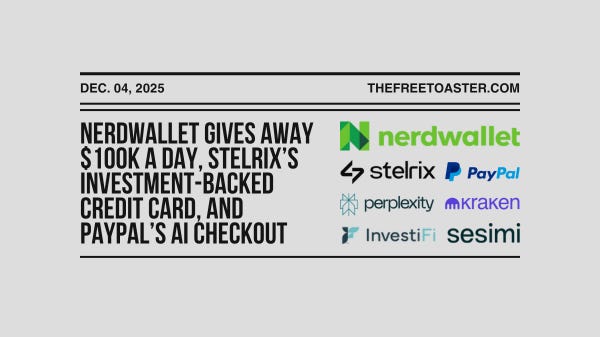
NerdWallet kicked off a daily $100k drawing, a holiday push that drives sign ups, repeat visits, and a steady stream of credit curious users. Stelrix introduced an investment-backed credit card that lets people borrow against their portfolios in real time, a model that has traditionally been locked behind private bank minimums. And PayPal and Perplexity rolled out Instant Buy, a chat-based flow that links product discovery to checkout as retailers prepare for the holiday wave.
Kraken launched a card that blends fiat and crypto. The Beige Book pointed to softer consumer spending. BNPL lenders responded to broad information requests from state regulators. Treasury Prime opened an AI marketplace for bank and fintech matching. U.S. Bank tested stablecoin issuance on Stellar. Black Friday came in weaker than expected. Visa, AWS, Klarna, Cozey, Zepz, and Google Finance all made moves across payments, lending, and AI driven commerce.
Quick note before we start: We’re hosting a small Q1 dinner in NYC for consumer lending teams to compare notes on direct mail. Want to join? Reply with “DM meetup” and we’ll keep you on the list.
Here’s what’s happening across fintech right now.
Happy Thanksgiving!
— Carlos Caro, Founder at New Market Growth
— Nick Madrid, Co-Founder of Uncovered Media and Ghostmode
PS: To support us, please ask one colleague to subscribe!

NerdWallet’s Daily $100K Draw: A $2.5M Boost for Holiday Engagement and Debt Support

Source: LinkedIn
NerdWallet is running a “Debt Free December” sweepstakes that gives away $100K a day from December 1 through December 25, with 25 total winners selected at random from registered users who enter on the site. The promotion is positioned as a way to help consumers pay down debt, though winners receive cash directly rather than creditor payments and are responsible for any taxes owed. Entry is free, limited to one per person and open to U.S. residents 18 and older, with daily drawings that roll over non winning entries. The campaign doubles as a user acquisition and engagement play for NerdWallet, driving account sign ups and data collection during the peak holiday spending season. The structure also creates 25 days of recurring touchpoints, which helps NerdWallet stay top of mind as consumers search for loans, credit cards and debt payoff tools. (NerdWallet)
Credit Reinvented: Stelrix Launches the First Investment-Backed Credit Card

Source: Stelrix
Stelrix is launching what it calls the first investment backed credit card, letting everyday investors borrow against their portfolios in real time instead of selling assets or relying on traditional margin loans. Built by 21-year-old founder Colin Sahagun, the platform continuously monitors a user’s brokerage holdings and adjusts credit limits every few milliseconds, removing the minimum balance requirements and slow approval processes that have kept portfolio backed credit limited to the wealthy. Stelrix has lined up partners across issuing, compliance and payments, including HSBC, Lithic, Sightspan and CompoSecure, with a beta planned for Q1 2026 and broader rollout in Q2. The company frames the product as a way to give retail investors access to private bank style liquidity tools, with plans to expand beyond equities into crypto, real estate and collectibles as it raises its next round and scales the infrastructure. (Stelrix)
PayPal and Perplexity Launch Instant Buy Ahead of Black Friday
PayPal and Perplexity are pushing AI shopping into the mainstream with Instant Buy, a feature that turns product discovery and checkout into a single chat flow. Consumers can ask for recommendations, compare options, and purchase inside Perplexity while PayPal handles identity, fraud checks, and payments. Retailers like Abercrombie, Fabletics, Ashley Furniture, Adorama, and NewEgg stay the merchant of record, and more than 5,000 merchants are already supported through PayPal’s store sync and agent ready tools. To spark adoption during the holiday rush, PayPal is offering 50% back up to $50 on a user’s first Instant Buy purchase between Nov. 25 and Dec. 1. Early AI shopping pilots across the industry have had mixed conversion, yet the shift toward conversational search is accelerating and recent tension between Amazon and Perplexity shows how quickly platforms are protecting their turf. For PayPal, Instant Buy builds on its ChatGPT integration and signals where ecommerce is going as payments move closer to the moment a customer decides what to buy rather than the moment they click checkout. (PayPal, PYMNTS)
What’s Next for 2026: Events Built for Operators, Not Crowds
If you saw Carlos’ recent post, you know the pain. Most conferences are too big, too broad, and too unfocused for the people who actually need to get work done in consumer lending. You spend days traveling for a handful of useful meetings and a lot of noise.
We think the industry deserves something better. Events designed for operators. Focused rooms. Real conversations. Two or three days where partnerships and growth teams can make progress instead of chasing down the right people.
We are working on a set of events for 2026 built around that idea. Some small. Some bigger. All structured so attendees walk away with value, not frustration.
If you want to help shape what these look like, reply to this email or message Carlos on LinkedIn. You can also review the post and share what would make an event worth attending.
We are listening.
And, most of all, we’re excited to see you in person in 2026.
BNPL’s Holiday Surge Meets a Regulatory Wake-Up Call

Source: Attorney General - Connecticut
BNPL is booming at the exact moment scrutiny is tightening. Holiday spending hit $10.1 billion from Nov. 1 to Dec. 1, the highest Adobe has ever tracked, with Klarna reporting a 45% jump in volume and Block seeing a 10% lift across Afterpay and Cash App. Adyen and Fiserv also processed more payments than last year. At the same time, seven state attorneys general sent sweeping information requests to Affirm, Klarna, PayPal, Afterpay, Sezzle, and Zip. The letters ask for underwriting policies, dispute procedures, credit reporting practices, delinquency data, and even screenshots of checkout flows. The inquiry, illustrated in the Connecticut and North Carolina letter to Affirm, reflects growing concern that rising BNPL use is outpacing consumer protections especially after the CFPB walked back its rule that would have treated BNPL like credit cards. The contrast is sharp. Demand is surging, delinquencies are climbing, and regulators are stepping in where federal standards are uneven. For fintech and lending teams, the message is clear. BNPL growth is no longer the headline. Governance and transparency are about to become the competitive edge. (Attorney General - Connecticut, Payments Dive, Payments Dive)
“Say Goodbye to Your Bank: Make Krak Your Everything Account”

Source: Kraken
Kraken is moving well beyond trading and positioning itself as a full alternative to traditional banks. The company launched the Krak Card, a Mastercard debit card that lets users spend from both fiat and more than 400 crypto assets with real time conversion and up to 1% cashback in local currency or Bitcoin. It pairs the card with salary deposits, global transfers, and Krak Vaults, a yield product offering up to ten percent APY through audited DeFi strategies. There are no FX fees, users can mix and match assets on a single purchase, and both physical and virtual cards are available. Kraken also secured full MiCAR authorization in the EU and continues to operate under the UK’s FCA, giving it a strong regulatory base as it pushes into everyday finance. Kraken wants to be the primary account for spending, saving, and earning, and it is building the kind of integrated, cross asset experience that puts pressure on both neobanks and incumbent banks. (Kraken, The Fintech Times)
Fed’s Beige Book Flags Consumer Spending Slide
The Fed’s final Beige Book of 2025 paints a clear picture of consumers pulling back as the year closes. Spending was the weakest category in the entire report, with broad signs of strain among low and middle income households who are trading down, delaying purchases, and avoiding big ticket items. General merchandise, restaurants, leisure travel, and autos all saw softer demand, and the expiration of EV tax credits and reduced SNAP benefits added another layer of pressure. Lenders reported mixed activity but a shared sense of caution as borrowers rely more on debt for basic expenses and banks tighten standards. Businesses echoed the same mood. Hiring has shifted to replacement only, capital spending is being delayed, and uncertainty around tariffs, interest rates, and consumer behavior is slowing plans for early 2026. The economy is still growing, but momentum is fading. The Beige Book’s overall tone is noticeably more negative than at the start of the year, signaling an environment where resilience is narrowing and caution is becoming the default. (Federal Reserve, PYMNTS)

Carlos sat down with Alex Johnson on the Fintech Takes Podcast to talk about how AI is changing distribution for lenders. The discussion touches on the collapse of organic traffic, the shift in acquisition costs, the rise of creator distribution, and what it means for publishers, affiliates, and fintech teams planning for 2026.
They cover:
How AI is disrupting SEO and SEM
What Google’s recent updates mean for lenders
Why creators are becoming core acquisition channels
What “GEO” could mean for the next wave of search
Listen here: Fintech Takes or The Free Toaster Podcast (reposted)
Treasury Prime Launches AI Marketplace to Transform Bank-Fintech Partnerships

Source: Treasury Prime
Treasury Prime launched an AI-powered Marketplace that uses LLM-driven matching to help banks quickly find and evaluate fintech partners aligned with their goals and risk profiles. The platform surfaces opportunities from a network of more than 3,600 fintechs and filters them by industry, funding stage, compliance appetite, and growth objectives. Banks get structured onboarding for vetted fintechs, while startups gain easier access to up to 17 bank partners through a single application. Treasury Prime positions this as the first step in a broader AI roadmap aimed at reshaping how embedded finance partnerships form and scale. (Treasury Prime)
Fast-Growing Fintech InvestiFi Partners with Sesimi to Scale Compliant Marketing
InvestiFi is partnering with Sesimi to help financial institutions produce compliant marketing content faster and at scale. The fast growing fintech will use Sesimi’s creative automation platform to deliver customizable assets with embedded disclosures and locked compliance language, reducing approval cycles and legal bottlenecks. The move reflects rising pressure on banks and credit unions to deliver personalized, omnichannel marketing without increasing regulatory risk. Both companies frame the partnership as a way to speed client onboarding, strengthen FI relationships and let marketing teams operate with fintech level agility while staying within strict compliance guardrails. (PR Newswire)
The OCC Just Removed A Major Barrier To Banks Entering Blockchain
The Office of the Comptroller of the Currency (OCC) just gave a practical green light for banks to finally get serious about blockchain technology. The new Interpretive Letter 1186 confirms that national banks can hold small amounts of crypto-assets for things like covering network fees ("gas fees") and testing new digital-asset platforms, resolving a major bottleneck that forced banks into "significant risks" and "operational drawbacks" before. The OCC framed this as a simple extension of longstanding bank powers, not a new departure, allowing banks to "avoid waste" and "improve efficiency". This clarity is "substantial" for both banks and their fintech partners, enabling direct, non-intermediated on-chain operations for things like custody and tokenization. Ultimately, this move removes the final operational hurdle, shifting the industry conversation from blockchain's place in banking to how quickly institutions can roll it out. (Forbes)
Enjoying this week’s issue?
If you’ve been enjoying The Free Toaster, help us spread the word. Forward it to someone who lives and breathes consumer lending, marketing, or fintech like you do.
Your shares help us reach more builders in consumer lending, and help us make the Newsletter & Podcast better everyday.
Visa and AWS Unite to Scale Agentic Digital Commerce

Source: Fintech Magazine
Visa and AWS are laying the groundwork for agent led commerce. Visa is bringing its Intelligent Commerce platform into AWS Marketplace, giving developers direct access to authentication, tokenization, intent capture and embedded payments designed for autonomous AI agents. Paired with AWS’s AgentCore blueprints, the setup lets agents complete full workflows like travel bookings, retail purchases and B2B payments without human intervention. Partners such as Expedia and Intuit are already experimenting, showing how quickly travel and financial platforms expect agent driven transactions to become normal. Commerce is fragmented across too many systems, and AI agents need a trusted execution layer to move from recommendation to purchase. Visa wants to be that layer, and the companies that control agent rails could end up with meaningful distribution power in the next cycle. (Fintech Magazine)
U.S. Bank Tests Stablecoin Issuance, Viewing Blockchain as ‘Alternative Payment Rail’

Source: PYMNTS
U.S. Bank is running live tests of issuing its own stablecoins on the Stellar blockchain, framing the network as a potential alternative payment rail for customers. The bank chose Stellar because it offers the controls regulated institutions require, including the ability to freeze or unwind transactions, built in asset safeguards, fast settlement and near perfect uptime. Leadership says the goal is twofold: be ready to onboard and offboard stablecoins into the banking system and be prepared to offer stablecoin based payments if client demand accelerates. Together with a new internal group focused on digital assets, custody and tokenization, the pilots show U.S. Bank positioning itself to operate on blockchain rails as soon as the market moves. (PYMNTS)
How Black Friday Became a Retail Letdown: ‘to Sustain the Ride, They Started to Dilute It’
Black Friday has lost its punch. What used to be a one–day stampede built on true doorbusters has stretched into a weeks-long promo cycle that keeps getting richer the closer you get to the holidays. Former Sears Canada CEO Mark Cohen says the event’s “integrity” is gone, and shoppers seem to agree. Online buying has overtaken stores for six straight years, foot traffic is flat, and spending across the Thanksgiving-to-Cyber-Monday window has dropped nearly 13% since 2019. Consumers are also growing wary of the discounts themselves, questioning whether the deals are real or just price resets dressed up as savings. (CNBC)
Synchrony and The Toro Company Launch New Credit Card for Financing Lawn Equipment

Source: Synchrony
Synchrony and The Toro Company are rolling out a co-branded credit card aimed at boosting sales for Toro, Exmark, Spartan and Z Turf Equipment dealers by giving customers flexible financing for lawn and landscaping equipment. The program includes digital applications, dealer support tools, and promotional financing options designed to drive larger purchases and repeat business. Synchrony is leaning on its PRISM underwriting system, which analyzes over 9,000 data points to make more accurate credit decisions and help dealers approve more qualified buyers. Dealers also get 24/7 support, marketing materials and training, positioning the card as a turnkey way to deepen customer loyalty and streamline the purchasing experience. (Synchrony)

Please support our Newsletter by recommending us to one of your colleagues!
And, please check out our sponsors:
Need an affiliate marketing platform/network? Chat with Fintel Connect
Need to improve application page conversions? Chat with Spinwheel
Need to accelerate your affiliate marketing? Chat with New Market Growth
Need to win on other growth channels? Chat with FIAT Growth
Looking for your next fintech role?
Stay ahead of where the industry is hiring. The Free Toaster Jobs newsletter curates standout openings in fintech marketing, product, data, and risk each week, along with insights into the trends shaping hiring across leading lenders, neobanks, and fintech startups.
Subscribe to The Free Toaster Jobs to get the latest roles and hiring insights delivered straight to your inbox (Toaster subs that don’t opt-in won’t get the Friday jobs Edition).
Missed last week’s edition? Check out the most recent job listings here.
Other News We’re Reading
(AI) HSBC and Mistral AI Join Forces to Accelerate AI Adoption Across Global Bank (HSBC)
(Retail) Gen Z Shoppers Aren’t Spending Like Retailers Need Them To (WSJ)
(BNPL) Attorneys General Form Multistate Coalition to Examine BNPL (PYMNTS)
(BNPL) NC wants more answers from six leading ‘buy now, pay later’ lenders (News & Observer)
(BNPL) Klarna Launches Tap to Pay for In-store Purchases Across 14 Markets (Klarna)
(BNPL) Cozey Partners with Klarna to Bring Flexible Payment Options to Online Shoppers in Canada and the U.S. (Klarna)
(Retail) Walmart Is Exploring Bringing Ads to Sparky, Its New AI Shopping Agent (WSJ)
(Cards) Zepz to Launch Stablecoin-linked Visa Cards, Powered by Bridge (Zepz)
(Cryptocurrency) Visa Partners with Aquanow to Enable Faster Settlement Using Stablecoins (Reuters)
(Cryptocurrency) Sony Wants to Launch a Stablecoin and So Does Everyone Else (Gizmodo)
(Cryptocurrency) Ripple and RedotPay Team to Bolster Stablecoin Remittances (PYMNTS)
(AI) AI Agents Trigger New Payments Regulatory Questions (PYMNTS)
(AI) AnChain.AI Announces Strategic Investment Round to Build Artificial Super Intelligence for Fighting Fraud (CBS 42)
(Fintech UX) Google Finance’s AI Upgrade Shows How Fast Fintech UX is Changing (DesignRush)
(Retail) Extended Holiday Sales, Effectively Black November, is ‘Confusing’ for Customers and Dilutes Shopping ‘Sparkle’ of Black Fridays and Cyber Mondays Past (Fortune)
(Regulation) N.Y. Law Could Set Stage for A.I. Regulation’s Next ‘Big Battleground’ (NYT)
(Regulation) FinCEN Issues Alert on Cross-Border Funds Transfers Involving Illegal Aliens (FinCEN)
(Money Mobility) Only 36 Percent of Gig Platforms Make Payouts Instant (PYMNTS)
(Bank Regulation) Lawmakers Ask Regulators to Abandon ‘One-Size-Fits-All’ Approach to Banks (PYMNTS)
(AI) Brands Shell Out Big to Get Noticed by AI Agents (PYMNTS)
(Cards) Fairway Home Mortgage Rolls Out Made for Home Credit Card (PR Newswire)
(Cards) Profitability of Credit Card Operations of Depository Institutions (Federal Reserve)
Spot something worth sharing with your team? Drop this week’s edition in their inbox:
Catch you next week,
The Free Toaster Team
p.s. If you’re working on anything new in acquisition or credit, we’re always curious to hear about it.