


Hi Toaster Readers,
Today’s piece is a sponsored deep dive. The sponsor provides valuable input, but we write, research, and edit the piece, and it’s an honest reflection of our thoughts on the topic.
Today’s essay adds a layer to a piece we wrote 2 years ago on how lenders will use cash flow data in their marketing programs.
Our thanks to Prism Data & Engine by Gen for sponsoring it!
We hope you enjoy it!
- Carlos & Nick
For years, the knock on cash flow data was simple: great for risk splitting, but the friction of collecting the data spelled trouble for marketers.
Underwriters love cash flow data.
Bank transaction data slopes risk incrementally to credit bureau data. In credit risk nerd speak, the two data sources are orthogonal. In layman’s terms, that means each data source helps predict credit risk, even after accounting for the predictive power of the other.
But marketers didn’t like what it did to their funnel, because the only way to get it was to ask a shopper to link their bank account, usually mid-application, and usually via a username-and-password screen. Drop-off went up. Conversion went down.
Many lenders concluded that cash flow data was too high-friction to use in a customer acquisition use case. (That’s why cash flow data has been commonly used in second-look programs and customer management programs like credit limit increase reviews).
That may be about to change.
Fresh off an announcement at The Affiliate Marketing Summit for Lenders and Publishers in San Francisco, I sat down with James Brandon of Prism Data and David Friermor of Engine by Gen to talk about what they just launched:
Prism Data’s cash flow intelligence, offered at the marketing stage in the Engine by Gen publisher network.
What Prism Data & Engine Announced at The Summit
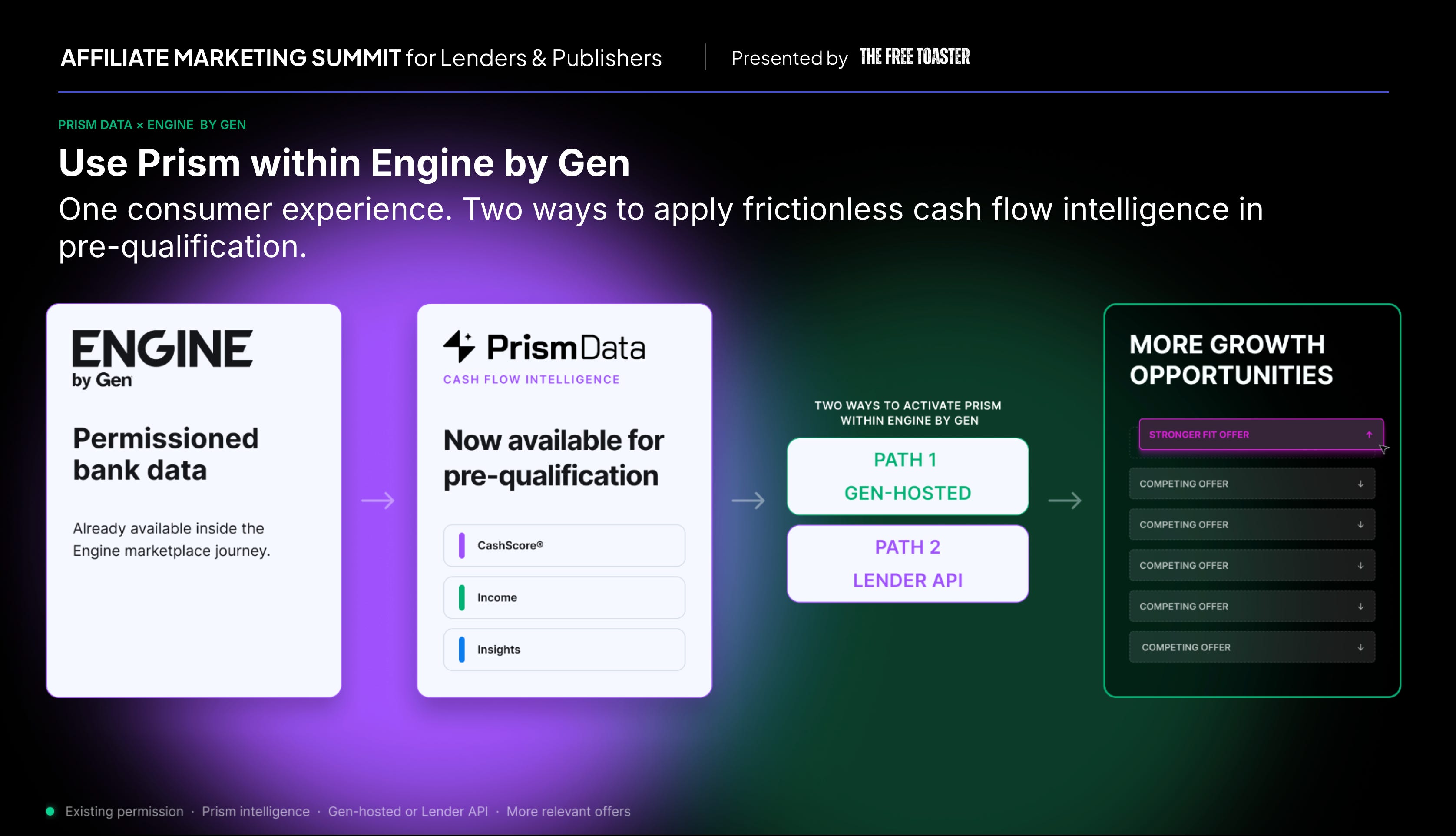
Lenders on the Engine network can now use Prism Data’s cash flow analytics to get predictive power from permissioned cash flow data at the marketing stage, not just at final underwriting. Engine’s Spark platform was already tri-bureau. Now there’s a cash flow layer sitting alongside the credit data, and lenders can use all those data sources together in their targeting model.
James described the cleanest fit as lenders trying to expand their buy box: personal loans, near-prime, subprime. But he was quick to add that prime lenders, credit cards, cash advance and other small-dollar products are well in-scope too. Real-time cash flow information improves credit decisions across the product spectrum.
Read more about this directly from Prism Data:
What About The Friction In The Application Flow?
Engine is embedded in thousands of places across the internet: publishers, PFM apps, even lenders selling their declines to other lenders. Adding a bank-link step in the application flow could hurt publishers, Engine, and conversion volume for the advertiser (lender).
Instead, when a lead comes through an Engine form, the PII gets matched against MoneyLion’s permissioned consumer base. MoneyLion sits in the same corporate family, and its users have linked bank accounts not only for MoneyLion’s first-party products, like Instacash and its banking products, but also for the Engine marketplace network and related partner offers.
David said the match rate is surprisingly high. When there’s a hit, Engine pulls the freshest transaction data, runs Prism Data’s cash flow analytics on it, feeds the attributes and scores into the lender’s model or knockout rules in Spark, and returns an offer in real time. No friction.
What if the shopper isn’t a MoneyLion user? No magic wand there yet, David shared.
They’d be asked to permission at that point. Expanding coverage beyond the MoneyLion base is something Engine is actively working on.
The Free Toaster Podcast recently sat with James Brandon of Prism Data and David Friermor of Engine by Gen to discuss how lenders can take advantage of cash flow data at the marketing stage (Apple Podcasts | Spotify).

Check out the episode on Apple Podcasts or Spotify.
What Prism Data Attributes Are Available Inside Engine?
The full Prism Data suite is available through the program, the same products many lenders already use for decisioning. Prism categorizes messy transaction data, then produces thousands of Insights attributes, an Income product that analyzes trending income, and CashScores® (multiple of them, on a 1-to-999 scale, which predict risk of credit default similar to a traditional credit score).
James called out the Income product in particular as enabling a far more accurate DTI calculation early in the funnel. Many Prism Data clients already use it to avoid income and identity stips, and it beats self-reported income or zip-plus-four estimates handily.
What Results Are Lenders Seeing So Far?
Prism Data clients see approval rate lifts of 5% to 30% at constant loss rates1. Those figures include the bank-linking step. Remove that friction, and both James and I expect the number could get even better.
Beyond approvals, David sees a second play: lenders re-decisioning existing customers who show up again on the network and moving them into a better product tier.
The key thing they’ll be looking for as the product scales?
How far lenders are able to expand their buy-box as a result of having the cash flow data and analytics at the marketing stage.
This is what will give consumers access to low-cost credit who might have otherwise been overlooked with credit bureau data only.

Why Wouldn’t Every Lender Use This?
I asked this on the Podcast. I was looking for what objections they hear from lenders when they discuss the product.
The first hurdle, James said, is comfort. Risk teams may never have worked with cash flow analytics, so Prism Data invests heavily in retro testing to help them set thresholds and build models. Spark’s champion-challenger A/B testing lets lenders expand the buy box incrementally while holding risk constant.
As an API native solution, the integration effort is low. It does require some coordination across Risk, Product, and Engineering teams, so lenders still have to believe the value is high enough to prioritize.
Want To Learn More?
If you’re already a Prism Data client, reach out to your Prism Data customer success team. If you’re already an Engine partner, reach out to your Engine account manager.
Looking to use both Engine and Prism? Submit the form at engine.tech.
Closing Thoughts
The tension marketers always faced with cash flow data was that more information upstream cost you conversion downstream.
This is the first setup we’ve seen where that trade-off mostly disappears. The bank link happens somewhere else, with a consent that carries through the funnel.
If Prism Data & Engine can scale this to a large enough segment of users, the cash flow underwriting category finally has a path to scaling from the customer acquisition side (in addition to the second-look programs and credit limit & pricing reviews that are already commonplace).
Catch you next week,
The Free Toaster Team
Carlos Caro, Founder at NMG, Co-Founder of The Free Toaster
Nick Madrid, Co-Founder of The Free Toaster and Uncovered Media
Based on a Prism Data retrospective analysis of lender samples, June 2026.