Hey Toaster Readers,
This week is sponsored by New Market Growth.
On October 20, Capital One announced Q3 earnings. Net income came in at $3.5 billion. Adjusted EPS was about 20% above what Morgan Stanley had modeled. And the stock didn’t move much. But this is a marketing newsletter, so we’ll stay in our lane and avoid commentary on the stock price.
Below are the nuggets we think a marketer at a card issuer or a bank would care about.
Let’s get toasting!
1. Marketing hit $1.6B this quarter, up 14%, and it’s growing faster than revenue
Rich Fairbank put the number in his prepared remarks:
“Total company marketing expense in the quarter was about $1.6 billion, up 14% year-over-year, driven by higher direct marketing in our domestic card business, increased media spend, and continuing investments in premium benefits.” (Rich Fairbank, Q3 earnings call)
Then Barclays asked how he measures the return. Part of his answer:
“It’s striking to notice that the growth rate of marketing over the last number of years has been higher than the growth rate of revenue and the growth rate of other expenses.” (Q3 earnings call)
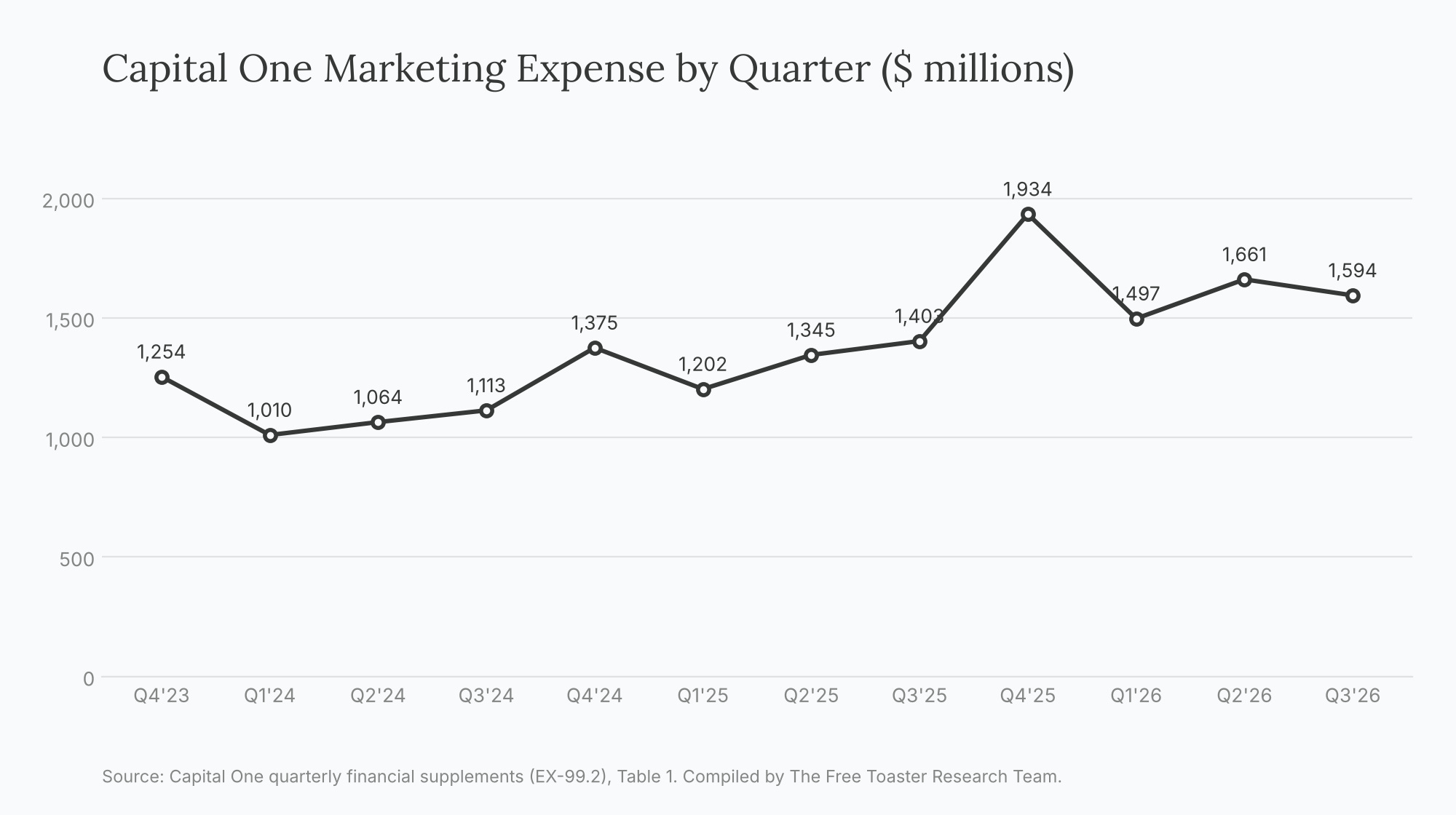
Marketing spend is growing faster than revenue, and Capital One is fine with that.
Domestic card revenue grew 5% year over year. Marketing grew 14% (Q3 earnings presentation). Morgan Stanley had modeled $1.77B of marketing against the $1.59B Capital One reported, and says 40% of its expense beat came from lower marketing (Morgan Stanley, “3Q26 Earnings: Cost Discipline Shines, but V/MA Settlement Casts a Shadow,” 2026-10-21).
Why you should care: If you’re a card issuer, an issuer spending about $1.6B a quarter on marketing just told investors it’s comfortable spending ahead of revenue, and the quarter it did that was a light one. Budget for mail volume and media costs to stay high through the holidays, and bring a sharper funnel if you want to keep your CPA where it is.
2. Q4 steps up like last year, and 2027 is bigger again
Capital One gave unusually direct guidance on where marketing goes next.
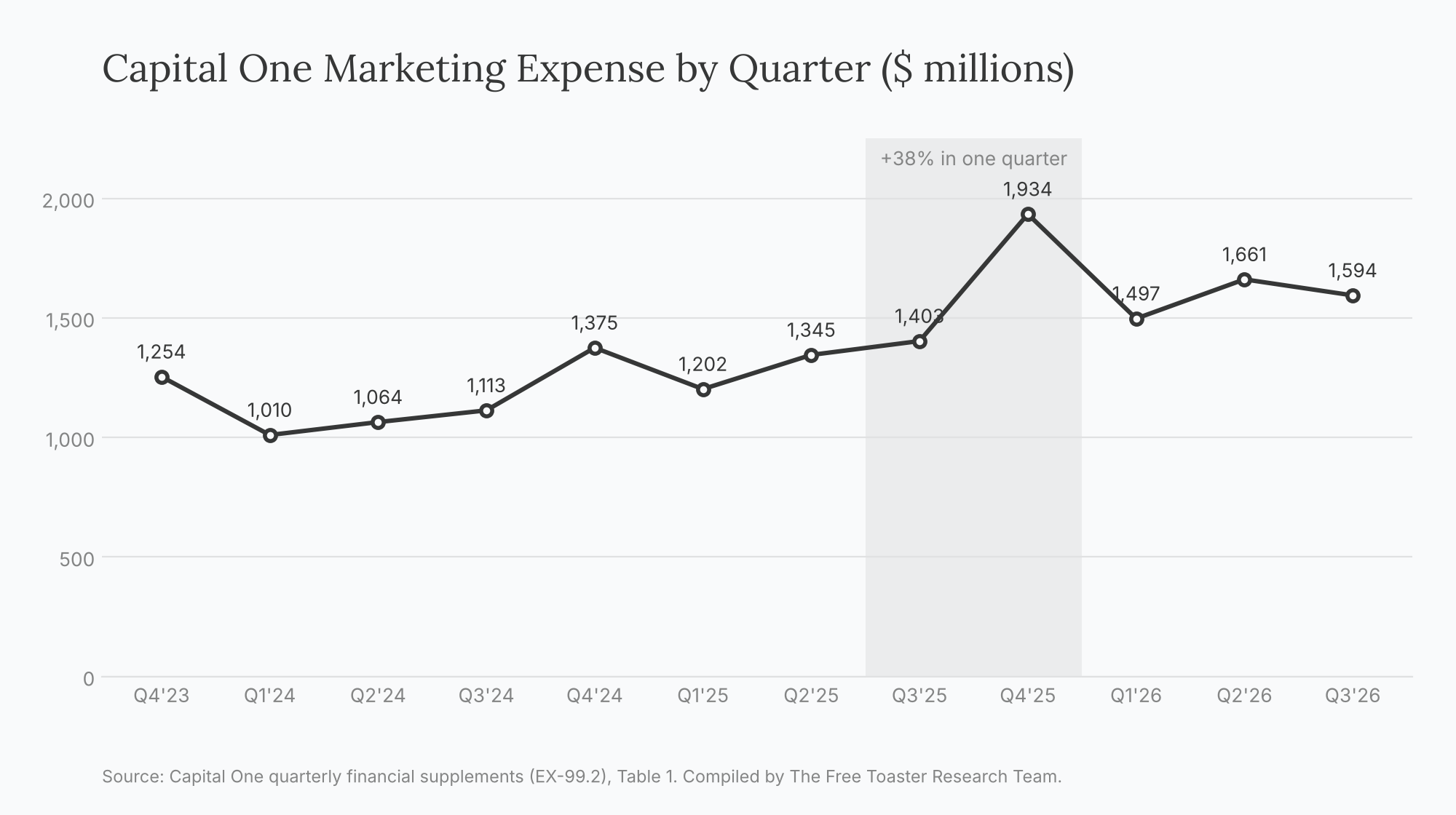
“As we look ahead to the fourth quarter, we expect the Q3 to Q4 percentage growth in marketing to be similar to the Q3 to Q4 percentage growth we saw in 2025, primarily driven by seasonality.” (Rich Fairbank, Q3 earnings call)
Morgan Stanley puts last year’s Q3 to Q4 step at about 38% (Morgan Stanley, “3Q26 Earnings: Cost Discipline Shines, but V/MA Settlement Casts a Shadow,” 2026-10-21). On $1.6B, that is a Q4 somewhere north of $2B.
Then the bigger line:
“Looking ahead, we expect to lean harder into marketing in 2027, driven by several factors. We’re fully pursuing our origination opportunities, and the window is open across our businesses. Our biggest competitors continue to invest heavily in marketing, and we need to be at the top of our game. Also, we plan to now lean back into Discover marketing.” (Rich Fairbank, Q3 earnings call)
Our biggest competitors continue to invest heavily in marketing.
Our translation?
Chase and Amex aren’t slowing down, so Capital One won’t either.
And Discover gets its budget back.
Why you should care: If you compete for prime and premium customers, Q4 and 2027 get more expensive. If you compete with Discover, a brand that has been nearly dark on acquisition for two years is coming back with Capital One’s mail machine behind it.
Sponsored by New Market Growth
Turbo-Charge Your Affiliate Marketing Program
Built by Free Toaster Co-Founder Carlos Caro, New Market Growth helps lenders build, scale, and optimize customer acquisition programs on marketplaces like Credit Karma, Experian, Engine, Lending Tree, Credible, and many more.
Free Toaster subscribers whose consumer card or consumer personal loan businesses spend more than $1M per month on affiliate marketing can get a free 30-minute consultation on a marketing problem they’re wrestling with.
Reply to this email with subject line “Consult” and Carlos will reach out to schedule the meeting.
Learn More About New Market Growth
3. The businesses Capital One is growing fastest are the ones that need the most marketing
Fairbank framed rising marketing as a mix shift, meaning the business is tilting toward products that are built with ads.
“The trend of marketing increases is also powered by a gradual mix change. Some of the biggest growth areas in the company are businesses where marketing is inherently a much larger component of the business model. That includes our quest at the top of the market with heavy spenders, Capital One Shopping, and our national banking business. These businesses take a lot of marketing to build, but are great franchises with lower risk, lower capital, and long-term revenue annuities.” (Rich Fairbank, Q3 earnings call)
On the bank specifically:
“All the other major banks out there, the growth strategy they have is buying other banks. That’s not our growth strategy. We are organically building a national bank and without a lot of branches on the corner, marketing is really the engine for that.” (Q3 earnings call)
That sounds like Capital One is replacing branches with ad spend.
Premium card is the other half of the story.
Fairbank said “the fastest-growing part of our card business is with the heavier spenders.” BofA’s take from its investor meetings earlier in October: Venture X is driving purchase volume and taking share, and Capital One competes on simple rewards and experiences rather than a “coupon book” (BofA Global Research, “Takeaways from COF in Toronto,” 2026-10-01).
Why you should care: On the deposit side, you’re competing for deposits against a company using marketing to build national reach without a large branch build-out. In the premium card market, Venture X, its lounges and travel portal are what you’re bidding against, and the budget behind them is expaning.
4. Capital One admits brand and lounges don’t fit a direct-response model
Asked how it measures marketing return, Fairbank split the budget in two. First, the part that’s measurable:
“The marketing machine of Capital One, much of it is a direct marketing machine that is pretty much stimulus response, measure things pretty quickly with respect to what we’re getting in terms of booking new accounts for an investment in marketing.” (Rich Fairbank, Q3 earnings call)
Then the part that isn’t:
“But there’s also a whole other component that doesn’t lend itself as easily to stimulus response thing, and I put at the top of that list building a brand. Also included in that is it’s hard to measure the return on investments in some of the things we’re doing at the very top of the market, the unique experiences, the Capital One Lounges.” (Q3 earnings call)
I put at the top of that list building a brand.
Our translation?
We measure the mailbox by response and the lounges by whether the business works.
Fairbank called that approach “horizontal economics,” his term for judging a whole business line over time instead of one campaign at a time. BofA heard the same thing in Toronto: Capital One sets no growth targets anywhere in the company, and marketing spend follows the opportunity rather than a budget (BofA Global Research, “Takeaways from COF in Toronto,” 2026-10-01).
Why you should care: If you’re defending a brand or experiential line item against a CFO who wants last-click attribution, you now have an issuer with a roughly $7B annual marketing budget on record saying brand and lounges get judged at the franchise level. That’s a nice little soundbite to share in your next finance meeting. And note the closing line: “we continue to be as bullish about marketing and the return on our marketing as we have been really at any time in this journey.”
Bonus: As fascinating case study on brand marketing ROI we covered in the newsletter almost 2 years ago.
5. Some quick hits before we wrap up
Discover marketing is coming back. All new Discover card originations are on Capital One’s technology as of September, the existing accounts convert by Q1 2027, and new originations grew year over year for the first time since the deal closed. Discover card loans still fell 2.9% (Q3 earnings call). Fairbank: “This brownout will not last forever.”
Brex gets Capital One’s leads now and its ad dollars soon. “We have already stood up a program to share high potential leads from across our businesses with Brex and are seeing very promising results at the outset.” And: “Over the coming months, as we test and learn, we’ll start leaning in with our marketing dollars.” Bringing the travel portal to Brex is “probably a next year kind of thing” (Q3 earnings call).
The Visa/Mastercard settlement offset Discover savings. Capital One said year-to-date results reflect about $1.8B in annualized combined synergies. Fairbank expects the pending settlement’s interchange impact to roughly offset the remaining synergies. Morgan Stanley sizes the hit at about $700M (Morgan Stanley, “3Q26 Earnings: Cost Discipline Shines, but V/MA Settlement Casts a Shadow,” 2026-10-21).
Rewards get a defense. Asked about the Credit Card Competition Act, Fairbank pointed to the value of rewards: “There is substantial competition in the payments industry already, with banks like Capital One taking a big portion of their interchange revenue and giving it to the consumer in the form of rewards.” He said a change “would be undesirable for consumers, merchants, and the economy.” (Q3 earnings call).
N=1 market research for Capital One. 100% of the reason Carlos keeps his Venture X account open is because of the Venture X lounges at DCA and IAD. Take that for whatever it’s worth.
Catch you next week,
The Free Toaster Team
Carlos Caro, Co-Founder of The Free Toaster
Nick Madrid, Co-Founder of The Free Toaster
PS: We’re actively planning our Spring 2027 Summit in NYC on April 7th and 8th! If you’re interested in sponsoring that event, please reply to this email or write us at info@thefreetoaster.com.